Renting a second home in Ticino: Lex Weber and tourist tax

The short answer
Yes, you can rent an apartment in Ticino as a second home, but three things decide how. The length: a holiday home let for three months or less comes without the usual tenant protections. The Lex Weber use restriction, which in 56 of Ticino's 100 municipalities can reserve newer apartments for people who live there. And the tourist tax.
Search for a second home to rent in Ticino and you mostly find listings, a few of them with the phrase «uso esclusivo come residenza secondaria» (for use as a second home only), and hardly anything explaining what that means for the person who signs. Here we bring together the federal and cantonal rules and two recent cases, Locarno and Tenero-Contra, with a link to every source. Federal laws are linked in their English translation; the canton's laws and the municipalities' documents exist only in Italian. This guide is for tenants, not buyers.
Holiday let or ordinary lease: the three-month line
The first thing to look at is the length of the rental, because it decides which law applies. The Code of Obligations' rules on renting homes "are not applicable to holiday homes hired for three months or less" (Art. 253a CO). A studio in Ascona taken for July and August is therefore a much looser contract than an ordinary tenancy.
In practice you lose some protections that tenants take for granted. The cap of three months' rent on the deposit, notice from the landlord on the official form, challenging the initial rent and extending the lease are all rules written for residential premises, so they don't apply here. The general rules remain: the landlord must hand over the place fit for use, and you must pay the agreed price. That's why, for a short let, it pays to have in writing the total price, which charges are included, the booking deposit and the cancellation terms.
Above three months, or if the place isn't a holiday home but an ordinary apartment you use as a weekend base, the whole of tenancy law applies. The deposit can't exceed three months' rent and must be paid into an account in your name, as we explain in our guide to the rental deposit. Notice follows the periods and dates in the lease or local custom, and the Ticino details are in our guide to ending a lease. The fact that the apartment is a second home for you takes none of these protections away.
But length is only half the question. The other half is about the apartment itself, because not every apartment may be used as a second home.
Lex Weber: where it applies in Ticino
The federal Second Homes Act, which grew out of the 2012 popular initiative and is known as Lex Weber, bans new second homes in municipalities where they already make up more than 20% of all homes (Art. 6 SHA). Legally, a second home is simply a home that isn't a principal home: nobody registered as resident in that municipality lives there, and it doesn't fall under one of the cases treated as equivalent (Art. 2 SHA).
Every year at the end of March, the Federal Office for Spatial Development (ARE) publishes each municipality's share. In the 2026 housing inventory, with data as of 31 December 2025, 331 Swiss municipalities are above the threshold. In Ticino, by our count in the same file, 56 out of 100 are subject to it, and together they hold 41% of the canton's homes.
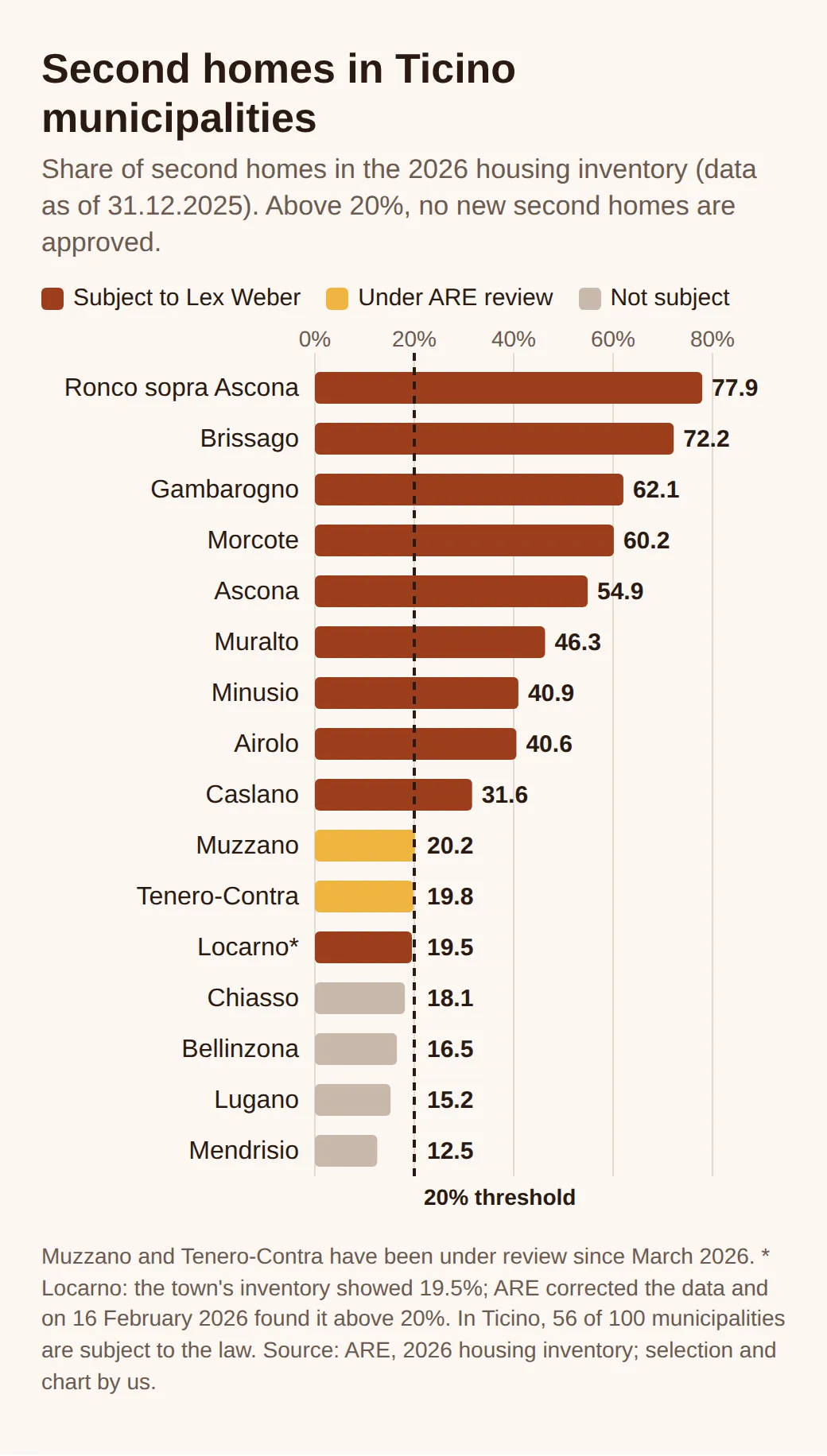
The pattern is stark. The shores of Lake Maggiore and Lake Lugano and the valleys are far above the line: Brissago has 72.2% second homes, Gambarogno 62.1%, Ascona 54.9%. Lugano (15.2%), Bellinzona (16.5%) and Mendrisio (12.5%) are well below it. Close to the line, single apartments count: in Muzzano, out of 466 homes, 94 second homes are enough to reach 20.2%, and with one fewer the municipality would be under the threshold.
Locarno is the most telling case. The town's own inventory put its share just under 20%. ARE checked, corrected the data and on 16 February 2026 found that the threshold had been crossed, as Locarno's municipal council announced. What tipped it was the correction for empty homes: under the law, an empty home counts as a principal home for two years at most, and after that as a second home (Art. 2 para. 3 let. d SHA). On 26 March 2026 the council decided not to appeal and began checking more than a thousand homes recorded as empty, ahead of ARE's next review.
In its press release of 31 March 2026, which has no English version, ARE named two Ticino municipalities above 20% for the first time: Muzzano and Tenero-Contra. They aren't subject to the law yet. They are in a review procedure, during which they can update their data. The inventory file puts Tenero-Contra at 19.8%, while its municipal council, in an answer from June 2026, gives 21% based on the Federal Register of Buildings and Dwellings. On its second homes page, ARE says the final decision comes by the end of October, so before you sign in either of these two municipalities, check the updated list.
What does this change for a tenant? The ban applies to new building permits, not to existing apartments. But apartments built after 2012 in these municipalities often come with a use restriction, and that restriction stays with the apartment when it is rented out.
How to tell if an apartment can be a second home
The answer depends on the building's history, and three questions get you there.
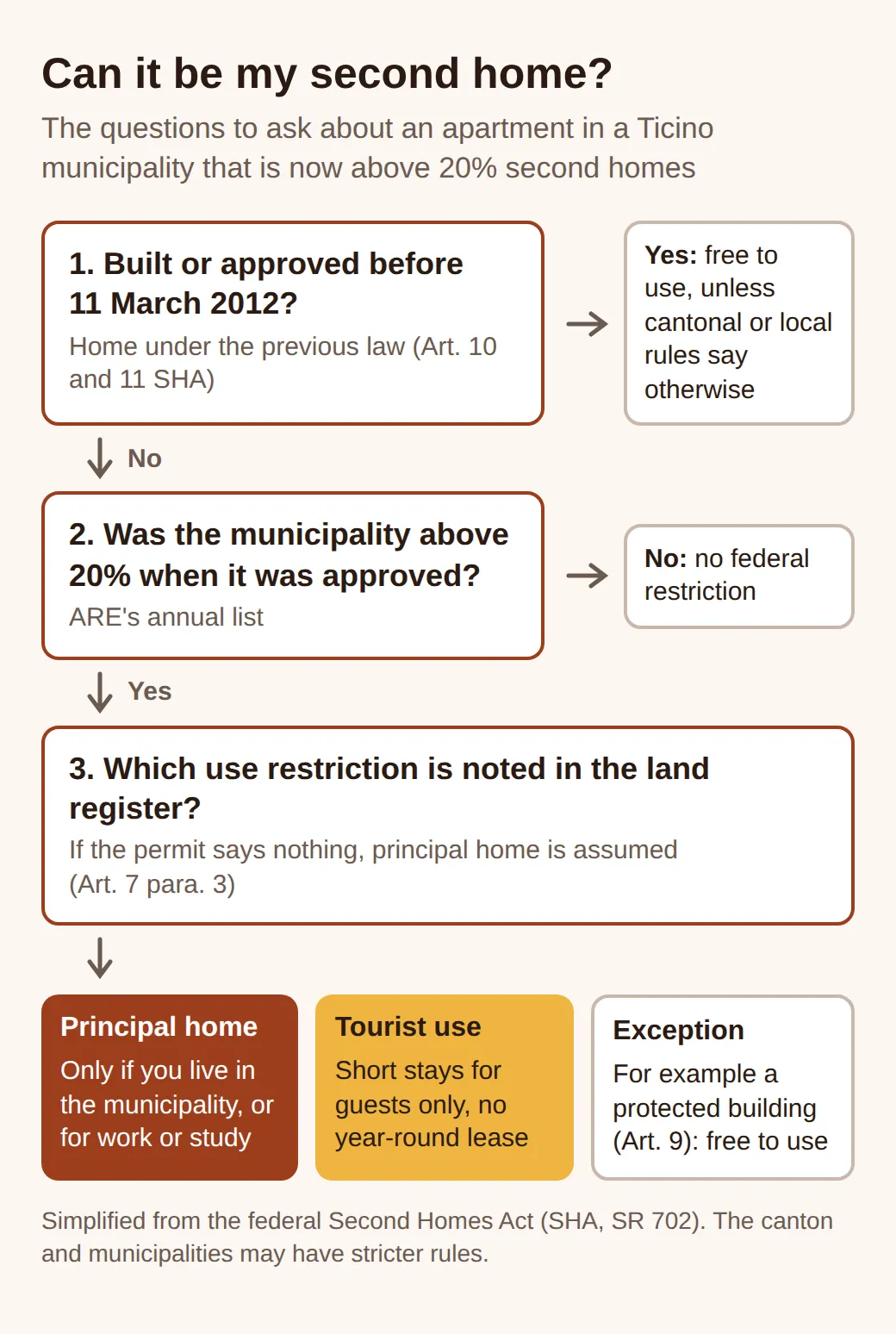
An apartment built or granted a building permit before 11 March 2012, the day of the vote, is a home "subject to the previous law", and you can use it freely (Art. 10 and 11 SHA). Such buildings may be extended by up to 30% of their main usable area, and since 1 October 2024 new homes may also be created within that limit, again without a restriction. Cantonal and municipal rules still apply: Locarno, for example, has limited second homes for decades through a rule in its local zoning plan, as the council pointed out in an answer to a councillors' question from November 2025.
For a newer apartment in a municipality that was already above 20%, what counts is the use restriction. The authority writes it into the building permit and has it noted in the land register (Art. 7 SHA). If the permit says nothing, the principal home restriction is assumed. There are two possible restrictions:
- Principal home: someone registered as resident in that municipality must live there. It won't do as a weekend second home.
- Managed tourist accommodation: it must be offered to guests on a lasting basis, for short stays only and at market rates. You can rent it for a holiday, but not on a year-round lease as a second home.
The simplest way to find out is to ask. Ask the landlord for the year of construction and whether the land register carries a note under the Second Homes Act, and have the answer written into the lease. The risk is real: anyone who wilfully disregards a use restriction faces a custodial sentence of up to three years or a monetary penalty (Art. 21 SHA), and the authority can set the owner a deadline and then seal the apartment (Art. 17 SHA).
Weekly residents: working or studying in Ticino during the week
Here the law is on your side. Homes permanently occupied for work or study count as principal homes (Art. 2 para. 3 let. a SHA). If you're registered in Zurich but work in Locarno from Monday to Friday, or study at USI in Lugano, you can therefore rent even an apartment restricted to principal home use. Tell the landlord, though, and put it in the lease, because the landlord is the one who answers to the municipality for the restriction.
Once you know the apartment can be used this way, the remaining question is what it costs on top of the rent. In Ticino the main item is the tourist tax.
Tourist tax: CHF 2 a night or a flat annual fee
The tax is paid by anyone who stays overnight as a guest in accommodation outside their home municipality, including apartments and houses let for tourist use (Art. 21 LTur). Ticino's tourism law (LTur) sets a range of CHF 0.50 to 4.50 per night; the cantonal government then fixes the amount for each type of accommodation.
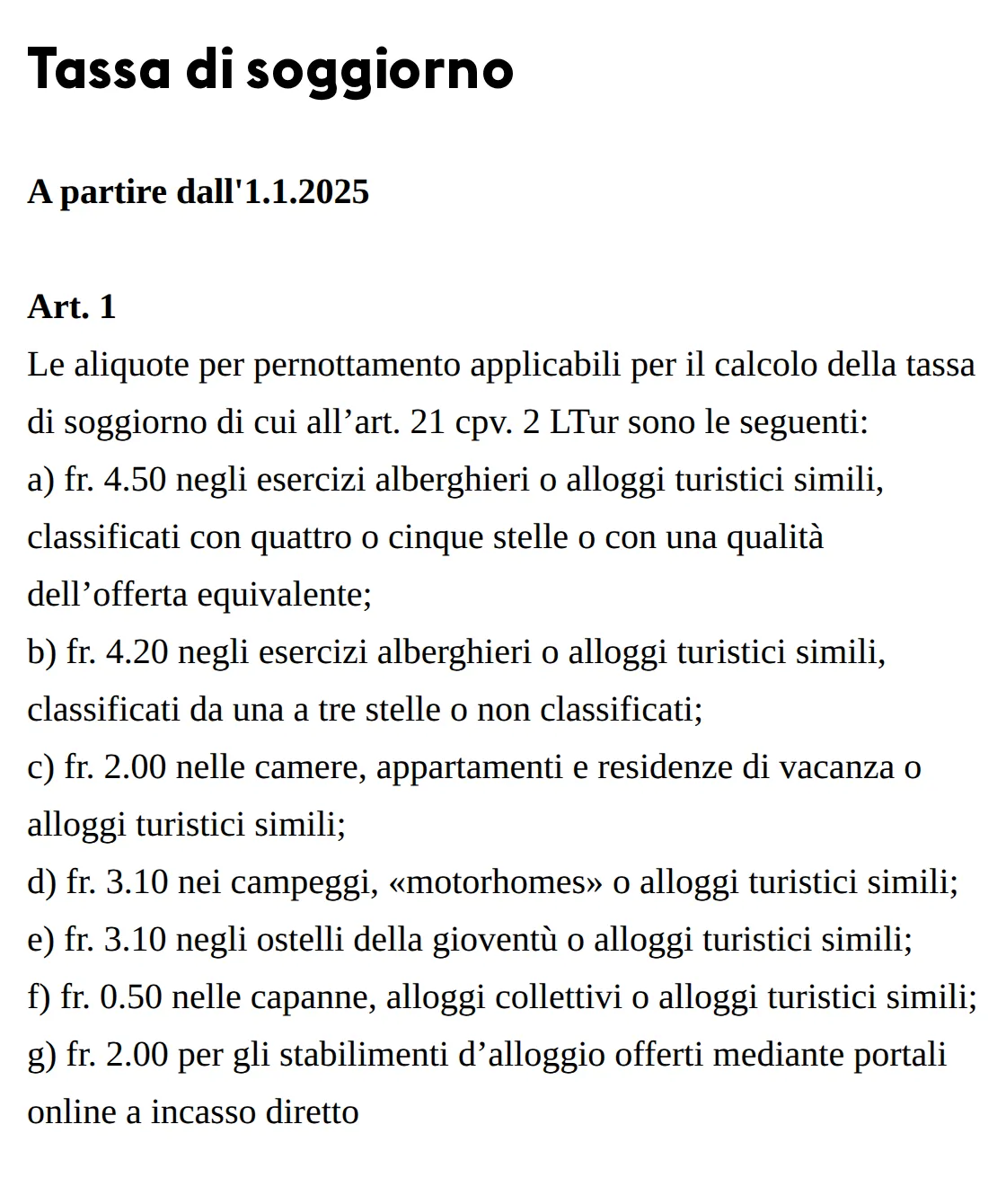
For a holiday apartment the tourist tax is CHF 2 per person per night, the same rate as for accommodation offered on online platforms that collect the tax directly (executive decree on tourist taxes). The landlord must charge it separately from the price of the accommodation and pass it on to the regional tourism organisation (Art. 12 RLTur). Two adults staying two weeks therefore pay CHF 56. Children under 14 pay nothing. The promotion tax of CHF 1.25 a night, by contrast, is charged by law to the host (Art. 23 LTur).
The sums change when the rental lasts longer. If you rent rooms, apartments or houses for tourist use for three months or more, you pay, like owners of holiday homes, a fixed annual amount instead of the nightly tax (Art. 21 para. 7 LTur). It ranges from CHF 15 to 100 per bed per year, depending on how accessible the place is and what it offers visitors, and each of the four regional tourism organisations sets its own. Houses more than 15 minutes' walk from the nearest road open to vehicles pay the minimum of CHF 15. It is due by 30 April of the tax year (Art. 13 RLTur).
| Situation | What you pay | Who pays it in |
|---|---|---|
| Holiday in an apartment, under 3 months | CHF 2 per person per night | The landlord collects it from you |
| Tourist let of 3 months or more | Annual flat fee of CHF 15 to 100 per bed | Owner and guest, by 30 April |
| Owner and family in their own holiday home | Annual flat fee per bed | The owner |
On one point the law stays vague: an ordinary year-round lease for an apartment used as a second home. The text speaks of accommodation let for tourist use, and not every long rental is that. Before you sign, ask the regional tourism organisation whether the apartment is registered for the flat fee, and state in the lease who pays it.
The ID number in the listing
Every place rented to tourists needs an identification number, issued through the platform of the Ticino tourism agency (Agenzia turistica ticinese), and the municipality must confirm that the accommodation is suitable. No listing may be published without that number, online or offline (Art. 21a LTur), and breaches can be fined up to CHF 10,000 (Art. 36 LTur). If you're looking for a holiday home, that makes for a simple check: a holiday listing with no number is a warning sign. Applications go through the municipality, which approves or rejects them. In Tenero-Contra, according to the council answer cited above, 45 second homes had an active authorisation in June 2026.
Registering with the municipality
A second home doesn't require you to move your official residence, but a long stay has to be reported. Federal law defines the "commune of residence" as the one where a person stays for a specific purpose, without intending to settle there, for at least three consecutive months or three months within one year (Art. 3 RHA). In Ticino, a Swiss citizen who has to be registered because they live or stay in the municipality reports to the residents' registration office (Ufficio controllo abitanti) within 8 days of arriving (Art. 12 of the cantonal regulation). Foreign nationals also register with the cantonal migration authority, under deadlines of their own (Art. 13).
The landlord has a duty too. Within 8 days, they must report to the residents' registration office every tenant who rents an apartment for more than 30 days within 360 days (Art. 16). The municipality may also keep a separate register of people living in second homes. Short holiday lets have their own reporting rule: according to Tenero-Contra's council, anyone renting an apartment to tourists must register the guests on the cantonal police portal within 24 hours of arrival.
If you want to rent your own home to tourists
The opposite case comes up too: living in Ticino and renting your apartment to tourists while you're away. In a building zone you don't need a building permit if the accommodation falls outside the law on hotels and restaurants and is rented for tourist use for no more than 90 days per calendar year, after notifying the municipality (Art. 3 of Ticino's building regulations). Beyond 90 days, as Locarno's council points out, you have to apply for a building permit for a change of use, and the municipality checks whether the new use fits the zone. Municipalities may have stricter rules.
In Locarno, 205 units have obtained a building permit since 2020 to operate as guest rooms (affittacamere). Listings for lets under 90 days, meanwhile, fell from about 150 in 2023 to about 50 in 2025, according to the same council answer. And if you're a tenant yourself, letting to others is subletting and needs your landlord's consent (Art. 262 CO), on top of the ID number and the tourist tax.
Before you sign
The lease is where you settle what no listing tells you. Besides the rent and service charges, ask for the length, the use as a second home and who pays the annual tourist tax to be put in writing. A clause like this one is enough:
The landlord declares that the apartment received its building permit before 11 March 2012, or that it is not subject to a use restriction under Art. 7 of the Second Homes Act, and that the tenant may use it as a second home. Any annual flat-rate tourist tax is payable by the [landlord / tenant].
If your lease is in Italian, as is usual in Ticino, the same clause reads: «Il locatore dichiara che l'abitazione è stata autorizzata prima dell'11 marzo 2012, oppure che non è gravata da una limitazione d'uso secondo l'art. 7 LASec, e che può essere utilizzata dal conduttore come residenza secondaria. L'eventuale tassa di soggiorno forfettaria annua è a carico del [locatore / conduttore].»
If the landlord hesitates to sign it, that tells you something as well. In municipalities below 20%, such as Lugano, Bellinzona and Mendrisio, Lex Weber doesn't come into play and only the cantonal and municipal rules apply. In the lakeside and valley municipalities, though, ask the questions in this guide before you fall for the view.
If you're looking now, you'll find listings from across the canton on our page of apartments for rent in Ticino, and those around Locarno on the page of apartments for rent in Locarno.
Common questions
Does a Lex Weber use restriction end if the municipality falls below 20%?
Not by itself. The law says that, at the owner's request, the building authority lifts the restriction and has the note deleted from the land register. Until that has happened, treat the restriction as still in force.
Who is liable if a restricted apartment is used as a second home?
The law punishes anyone who wilfully disregards a use restriction, with a custodial sentence of up to three years or a monetary penalty. The administrative measures, such as a deadline to restore lawful use or sealing the apartment, are aimed at the owner. A tenant who knew about the restriction is therefore not in the clear.
Do children pay tourist tax in Ticino?
No, guests under 14 are exempt, except where the tax is charged as a fixed annual amount. Pupils and students of state-recognised schools and of USI and SUPSI are exempt too.
Can I sublet my rented second home to tourists?
Only with the landlord's consent, because it counts as subletting. The landlord can refuse only for specific reasons, for example if your terms are unfair compared with the main lease. After that, the rules for tourist accommodation apply: an ID number, registering your guests and the tourist tax.
Does a holiday let of more than three months count as a normal lease?
Yes. Under the Code of Obligations the exception only covers holiday homes let for three months or less, so beyond that the rules for residential premises apply, including those on deposits and notice. For the tourist tax, on the other hand, a let of three months or more pays the fixed annual amount.
More from the blog
All posts
Where is rent cheapest in Ticino? The five regions compared
Where rent is cheapest in Ticino: prices in the five regions from cantonal data, with train times and travelcard costs to Lugano.
Pets in a Swiss rental apartment: what landlords can ban
Pets in a rented apartment in Switzerland and Ticino: small animals, landlord consent for dogs and cats, damage, the deposit and what the courts decided.
Ancillary costs in Ticino rentals: what you really pay
Ancillary costs on a Ticino rental: which items you pay, advance payments or flat rate, what the yearly statement must show and how to dispute a high bill.