Rent deposit in Ticino 2026: limit, insurance and refund

The short answer
In Ticino, your landlord can ask for at most three months' rent as a deposit. They must pay it within 10 days into a blocked account in your name, at a bank with a presence in the canton. When the lease ends, the money comes back to you with interest; if the landlord takes no action within a year, the bank pays you even without their signature.
The rules fit in a few lines. The trouble comes later: an account the landlord never opens, insurance that costs more than expected, a landlord who won't sign the release when you move out. For each one you'll find the rule, a link to check it and, where there is one, a case that ended up in court.
How much can your landlord ask for?
Three months' rent at most, and only if the lease provides for a deposit. That's set by art. 257e of the Swiss Code of Obligations (CO), the federal rule that governs the whole topic: "In residential leases, the landlord is not entitled to ask for more than three months' rent by way of security." If the lease says nothing, no deposit is owed.
The law doesn't say whether those three months include ancillary costs such as heating and hot water. In practice they do: the fact sheet from the tenants' association in German-speaking Switzerland, the sister organisation of Ticino's ASI, counts three months including the flat rate or advance payment for ancillary costs, and Ticino's social support office puts it the same way: three monthly rents with the related ancillary costs. So with a rent of CHF 1,500 a month including ancillary costs, the maximum is CHF 4,500. If your landlord asks for less, all the better; more isn't allowed.
The cap applies to homes. For a shop, an office or a storeroom, the law sets no maximum. One thing applies to every lease, though: where the money ends up.
The account must be in your name
The landlord must deposit the money "in a bank savings or deposit account in the tenant's name", in other words in yours. Not in their own account, and not as cash in the property manager's drawer. Ticino adds its own rules in its act implementing federal tenancy law (RL 222.100), which exists only in Italian.
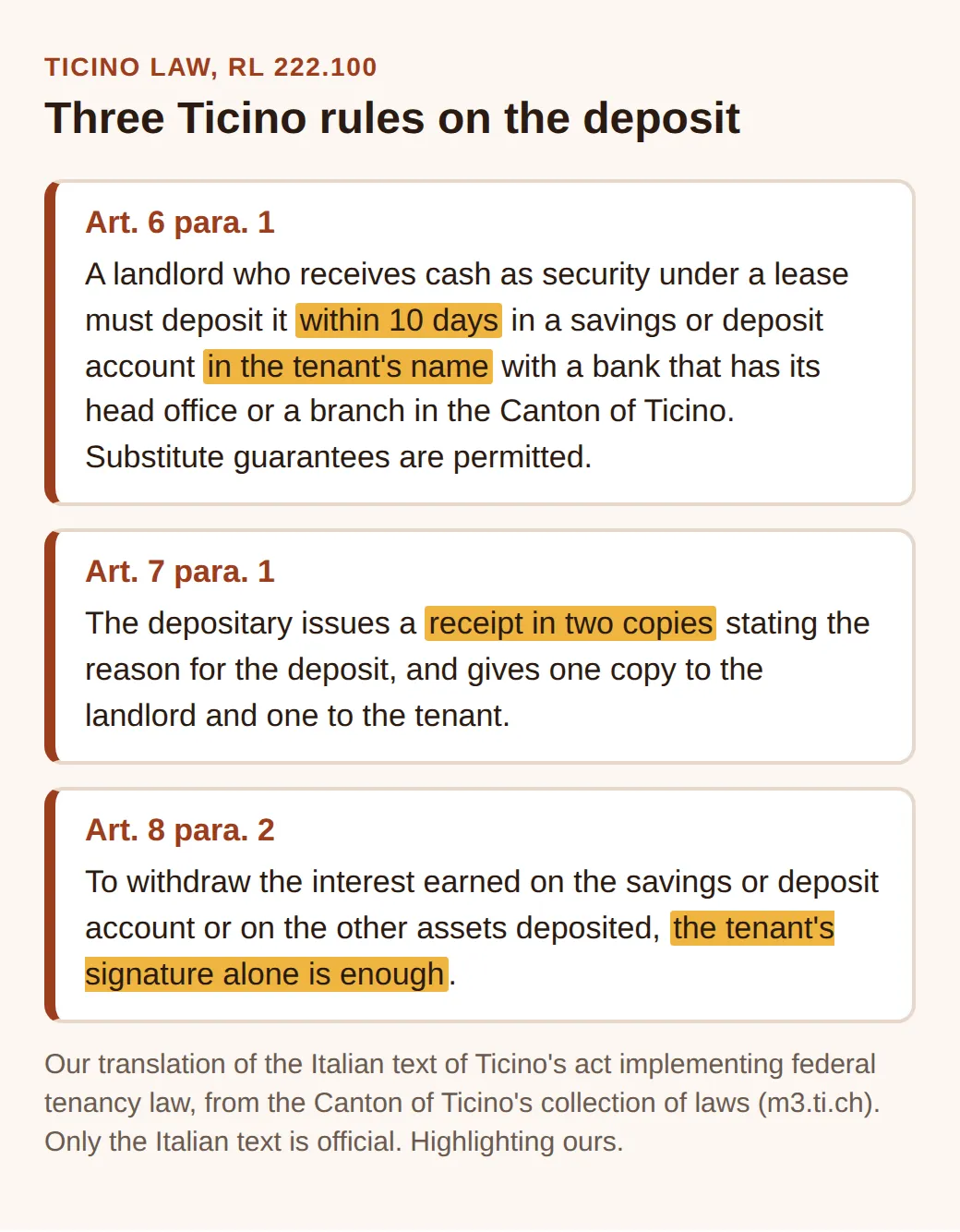
In practice, a landlord who receives cash as a deposit has 10 days to pay it into a savings or deposit account in your name, at a bank with its head office or a branch in the Canton of Ticino. The bank issues a receipt in two copies stating what the deposit is for: one goes to the landlord, one to you. These rules can't be changed in the lease to your disadvantage (art. 10), and anyone who breaks them risks a fine of up to CHF 2,000 (art. 11), with no ceiling if they act as a fiduciary or property manager or for profit.
Why fuss over a banking detail? Because an account in your name is what protects the money if the landlord goes bankrupt. In ruling BGE 127 III 273 of 21 March 2001, the Federal Supreme Court looked at the case of a courier firm that had paid a CHF 15,000 deposit in 1994 for offices, storerooms and parking spaces. The company that owned the premises never put the money in an account in the tenant's name, and went bankrupt in 1997. The tenant tried to offset that sum against the rent it owed the bankrupt estate, and the court said no. A deposit properly held at a bank stays outside the bankruptcy; one mixed in with the landlord's money becomes part of the estate, and all the tenant has left is a claim against the bankrupt company, alongside every other creditor.
That's why, as the Zurich courts point out with reference to that ruling, it's up to you to check that the deposit is properly at the bank. The tenants' association in German-speaking Switzerland adds that until the blocked account exists you don't have to pay, and that you can refuse to pay in cash or into the landlord's private account. If you've already paid and the landlord still doesn't open the account after a reminder, you can offset the amount against future rent, telling them so by registered letter. Before you do, though, get advice from the tenants' association: a mistake here can cost you dearly.
The interest is yours
The deposit stays your money while it's blocked, and so does the interest. The law doesn't set the rate; the bank does, and it can be very low. To take one example, Migros Bank's product sheet, updated on 1 May 2025, shows a credit interest rate of 0.000%, with no fees for opening or running the account.
Ticino gives you an extra advantage here. According to the tenants' association in German-speaking Switzerland, many banks treat the interest as blocked too, and the same Migros Bank sheet asks for both the tenant's and the landlord's signature to withdraw it. Ticino law, on the other hand, is clear (art. 8 para. 2): to withdraw the interest earned, the tenant's signature alone is enough. Every year the bank sends you a statement with the interest calculation. Keep it, because you'll need it when the lease ends.
A blocked deposit at zero interest costs you nothing, but it ties up a large sum right when you move, as the bills pile up. That's where the alternative comes in.
Rent deposit insurance instead of a cash deposit: what it costs
Ticino law allows "substitute guarantees". In practice, these are companies that give the landlord a guarantee certificate in place of the cash, in return for an annual premium paid by you. You need the landlord's agreement, though, because the type of guarantee is usually written into the lease: even SwissCaution tells you to ask the landlord for approval before replacing a bank deposit.
Here are the prices three providers publish:
| Offer | Annual premium | Extra costs | Worth knowing |
|---|---|---|---|
| SwissCaution through Swiss Post | 5% of the guarantee | CHF 20 admin fee, 5% stamp duty | Loyalty discount: 10% after 2 full years, 30% after 4 |
| Firstcaution | 5% (5.5% if you pay monthly) | CHF 20 management fee, federal stamp duty | Flat-rate premium in year one; 20% of premiums back under certain conditions |
| Helvetia | 4% | No admin fee | Maximum guarantee CHF 18,000 |
With the guarantee in our example, CHF 4,500, 5% plus the fee and stamp duty comes to about CHF 257 a year. At 4% it's CHF 180: Helvetia's page doesn't say whether stamp duty is included, and if it isn't, it comes to CHF 189. That sounds small, but you pay it every year and never get it back.
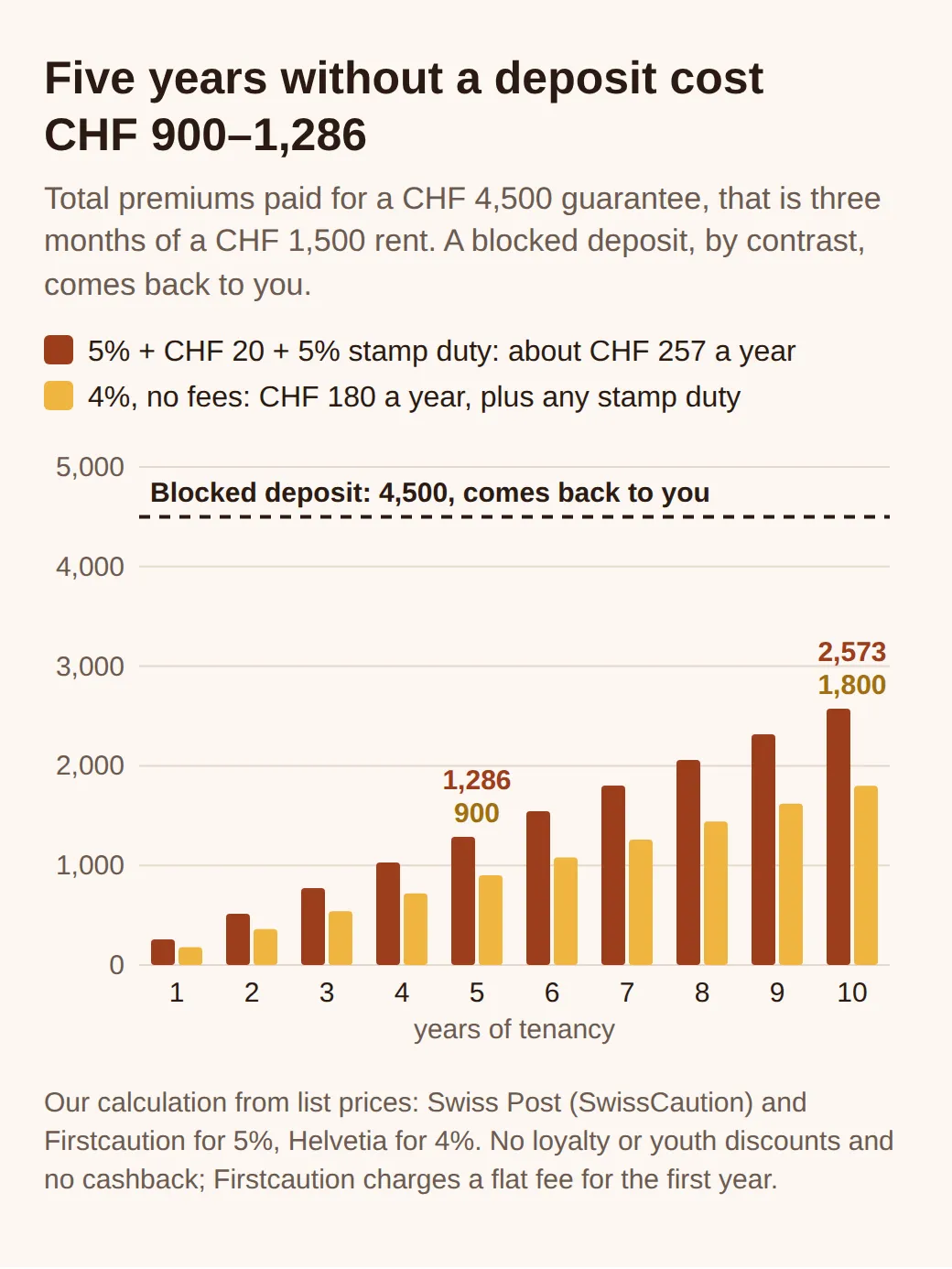
After five years you've spent between CHF 900 and about CHF 1,286, before loyalty discounts or cashback, which can bring the bill down. But there's something the price doesn't tell you: this insurance isn't liability insurance. If the landlord claims money and the company pays, it then claims it back from you. Swiss Post says so plainly: "You must then reimburse SwissCaution the amount paid to your landlord."
Then there's the end of the lease. The guarantee doesn't close by itself when you move out: according to SwissCaution's FAQ, you need the certificate, dated and signed by the landlord, who has up to 12 months to release it, and the annual premium is due until the guarantee is released. With Helvetia, if you cancel in the first year, you still pay the full annual premium.
Deposit or insurance: which makes sense?
If you have the money, the blocked deposit costs less: when the lease ends, you get it all back, interest included. Insurance makes sense if you really don't have that sum or need it for the move, and for short periods. The tenants' association in German-speaking Switzerland advises against it and suggests a private loan instead if you're short of cash. Ticino's social support office, when it has to help someone, also gives priority to the insurance route: for people with no savings, it can be the only way to sign the lease.
Getting your deposit back after you hand over the keys
The normal route is simple: you and the landlord sign a release order together and send it to the bank. Art. 257e para. 3 CO puts it this way: the bank may release the deposit "only with the consent of both parties", or on the basis of a final payment order or a final court decision. If everything is in order, consent to the release can go straight into the handover report, as the tenants' association suggests.
When you hand the apartment back, the landlord must inspect it and tell you "immediately" about any defects you're answerable for, says art. 267a CO. If they don't, you're off the hook, except for defects a normal inspection couldn't have found. Where repairs are needed, the tenants' association considers about three months a reasonable time for the landlord to collect the invoices and send you the final statement. You have the right to see the invoices.
Only sign the release order if you agree with the amount. If the landlord drags their feet or holds back too much, a short registered letter is enough to set a deadline:
Please sign, within 30 days, the release order for the rent deposit of CHF 4,500, account no. [...] at [bank], together with the interest earned. I dispute the costs listed in your statement of [date] for the following reasons: [...]. If I do not hear from you, I will contact the conciliation office.
If even that doesn't work, you have two options: go to the conciliation office, or wait. And the wait has a fixed end date.
The one-year rule
If within a year of the lease ending the landlord has brought no legal claim against you, you can ask the bank for the deposit directly, without their signature. That's the last sentence of art. 257e para. 3 CO. A year is a long time, and meanwhile the money sits idle, but the landlord can't stretch that deadline by keeping quiet.
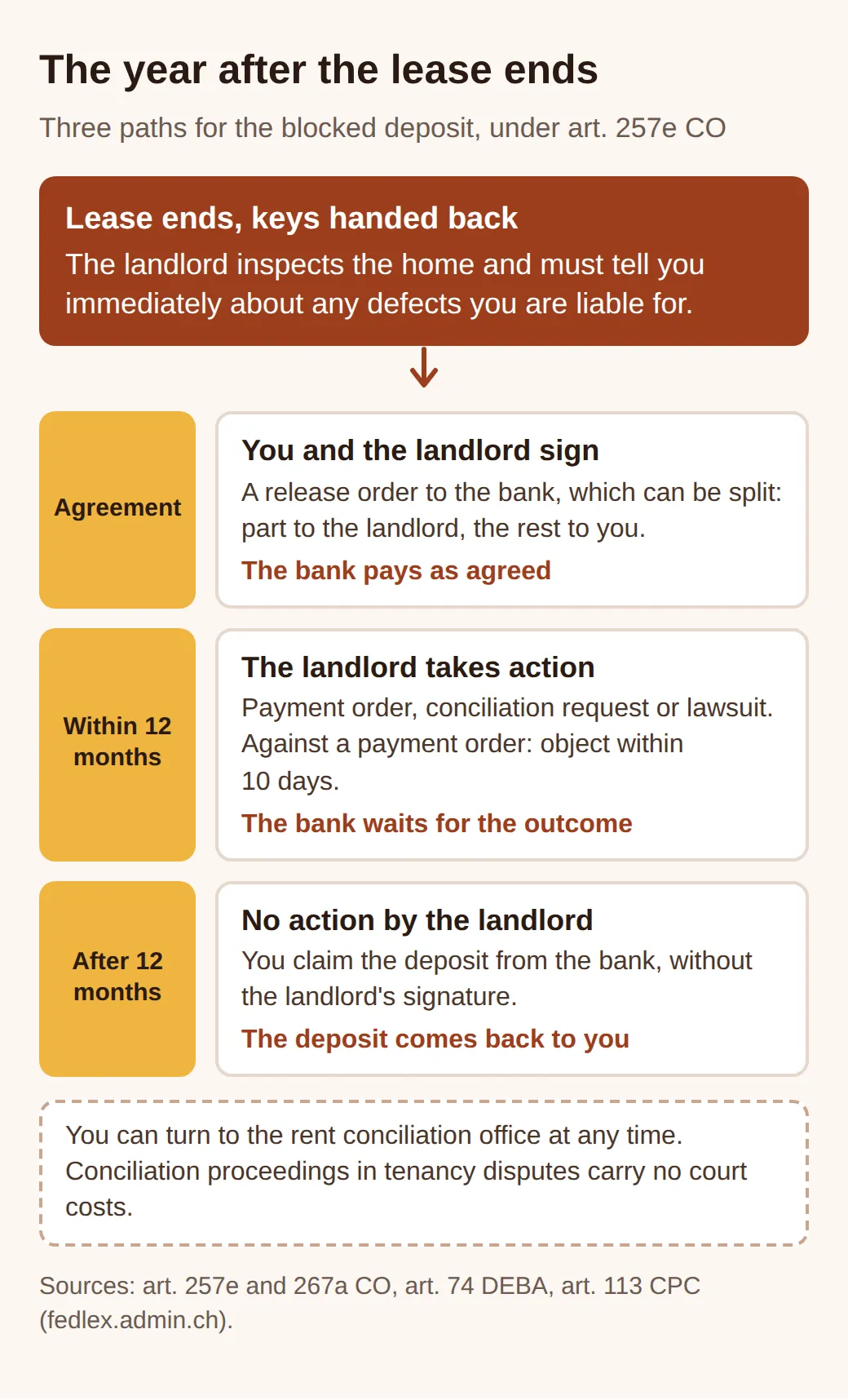
Three things matter. The first is the date: the year runs from the end of the lease, not from the day you handed back the keys, if the two dates differ. The second is what counts as legal action: according to the tenants' association, a payment order, an application to the conciliation office or a court case. A letter disputing costs doesn't count. The third is practical: to pay out without the landlord's signature, the bank will usually ask for the termination letter and the handover report. Keep them somewhere safe.
If the landlord acted in time, the bank waits until the proceedings are over. And that's where the payment order becomes the decisive moment.
If you get a payment order
Don't leave it in a drawer. A payment order (precetto esecutivo in Italian, Zahlungsbefehl in German) is the document a creditor uses to start debt collection through the debt enforcement office. If you don't agree, you must object straight away to the person who delivers it, or to the debt enforcement office within ten days, orally or in writing (art. 74 of the Debt Enforcement and Bankruptcy Act, DEBA). Without an objection the payment order becomes final, and the bank can pay the landlord out of your deposit.
An objection doesn't settle the matter, but it shifts the burden to the creditor: they have to ask a court to set your objection aside. If they hold a document signed by you in which you acknowledge owing a specific sum, they can ask for it to be set aside provisionally (art. 82 DEBA), a fast procedure in which the judge looks only at the documents. That's why what you sign on handover day matters so much.
A case from the Canton of Vaud shows this well, and it involves insurance. In January 2019 a couple left a 4.5-room apartment in Mont-sur-Rolle. The handover report, signed on a tablet, contained a clause stating that it counted as an acknowledgement of debt and authorising the property manager to take CHF 7,350 from the guarantee. The guarantee company paid the landlord, then claimed the money from the tenants and sent a payment order to the wife, who objected. The justice of the peace, and then the Vaud Cantonal Court in its ruling of 14 February 2020 (in French), refused to set the objection aside provisionally: the tablet signature wasn't a qualified electronic signature, and the tenants disputed that they had acknowledged that debt.
The tenants won this round mainly because of the form of the signature, and the court notes that this procedure doesn't decide who is right about the debt. With a handwritten signature on the same report, the outcome might have been different. The lesson holds with or without insurance: don't sign an acknowledgement of debt on handover day if you don't agree with the figure.
If your landlord doesn't respond: the conciliation office
You don't have to wait a year. If the landlord won't sign the release and you believe you owe nothing, you can file an application with the rent conciliation office (Ufficio di conciliazione in materia di locazione) for your district and ask for the deposit back. In tenancy disputes, conciliation proceedings carry no court costs (art. 113 of the Civil Procedure Code), and Ticino law points to exactly this procedure for disputes over the deposit (art. 8 para. 3).
For advice before you act, ASI, the tenants' association for Italian-speaking Switzerland, has offices in Massagno, Balerna, Locarno and Bellinzona, and sees people in Biasca by appointment on Friday mornings. The association offers information and help with disputes to its members: membership costs CHF 120 for the first year and CHF 70 for each renewal, with a three-year commitment for new members. On a deposit of a few thousand francs, the fee soon pays for itself if the landlord keeps more than they should. ASI's pages are in Italian.
Before you sign your next lease
The moment you really protect your deposit isn't the handover, it's the signing. Check that the amount is no more than three months' rent, that the account is opened in your name at a bank with a presence in Ticino, and that the receipt reaches you within a few days. If you're thinking about insurance, work out the cost over several years with the chart above and ask the landlord in writing whether they'll accept it. Then keep the lease, the receipt, the annual statements and, later, the termination letter and the handover report together in one folder: those are the documents the bank will ask you for.
If you're looking for a home right now, you'll find listings across the canton on our page of apartments for rent in Ticino.
Common questions
Can I use my rent deposit to pay the last months of rent?
No. While the lease runs, the account stays blocked for both sides, so you can't offset overdue rent against the deposit. If you stop paying, the landlord can set you a payment deadline and then terminate the lease for arrears, and the deposit stays blocked until the end anyway.
Can my landlord ask for a bigger deposit during the tenancy?
Only as a change to the lease, notified on the same official form used for rent increases and in line with the notice periods. You can challenge it at the conciliation office within 30 days of receiving it. Even after the increase, the total can't exceed three months' rent.
What happens to my rent deposit if the apartment is sold?
The lease passes to the new owner and, under Ticino law, the old landlord must hand over control of the account to them. At the new landlord's request, the bank updates the receipt and informs both parties. But if the old landlord never put the deposit in a bank, the Federal Supreme Court has held that the duty to do so does not pass automatically to the buyer, which is why it pays to check the account from day one.
Can social services pay my rent deposit in Ticino?
In Ticino, the Office for Social Support and Integration (Ufficio del sostegno sociale e dell'inserimento) can advance it, in principle only if there is no earlier deposit already. It first asks you to consider insurance or to negotiate with the landlord, has you sign an acknowledgement of debt and pays the money only into a deposit account in the tenant's name. If you go for insurance, it can pay the premium and recover it through deductions from your benefits.
Is there a deposit limit for shops and offices?
No. The three-month cap applies only to homes; for commercial premises the law sets no maximum. The duty to pay the money into a bank account in the tenant's name, on the other hand, applies to commercial premises too.
More from the blog
All posts
Mould in a rented apartment: who pays? The rules in Ticino
Mould in a rented apartment in Switzerland: when the landlord pays and when you do, how much rent reduction Ticino courts grant and how to claim it.
Ancillary costs in Ticino rentals: what you really pay
Ancillary costs on a Ticino rental: which items you pay, advance payments or flat rate, what the yearly statement must show and how to dispute a high bill.

Renting a second home in Ticino: Lex Weber and tourist tax
Renting a second home in Ticino in 2026: the three-month rule, the 56 municipalities under Lex Weber, the tourist tax and what to check before you sign.