Mould in a rented apartment: who pays? The rules in Ticino
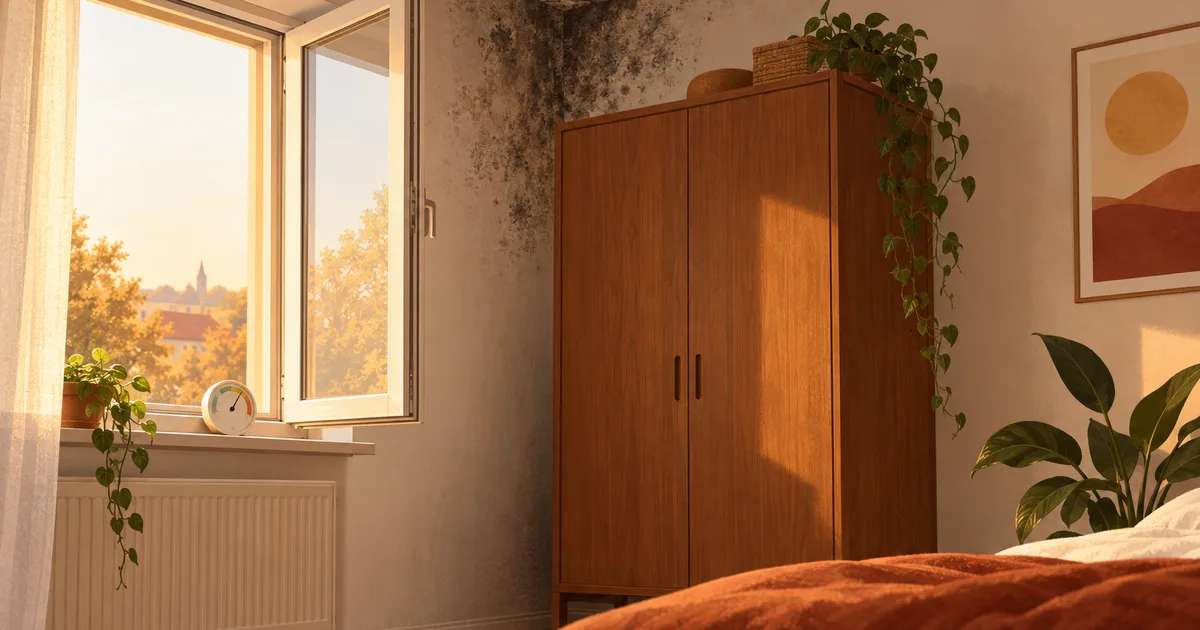
Who pays, in short
The landlord pays when the mould comes from the building: cold, poorly insulated walls, water getting in, a faulty roof. You pay when it comes from how you use the apartment, for example if you rarely air the rooms or dry laundry in the bedroom. Small traces on the bathroom grout are yours to clean either way. When there are two causes, Ticino courts grant a smaller rent reduction.
Almost every Italian-language page that answers this question explains Italian law, with the Italian Civil Code and Italy's Court of Cassation. In Switzerland other rules apply: those of the Code of Obligations (CO) on defects in rented property. We read them alongside seven rulings of the Ticino Court of Appeal from 1995 to 2018, the mould brochure of the Federal Office of Public Health and the cantonal rules on the municipal expert, who costs CHF 80 an hour in Ticino. The result is a clear path: what counts as a defect, how to prove the cause, how much you can cut the rent and why you should never stop paying it.
Building defect or misuse: who pays for what
The basic rule is simple. The landlord must hand over the apartment in a condition fit for living in and keep it that way for the whole tenancy (art. 256 CO). If a defect appears that isn't down to you, you can ask the landlord to fix it, reduce the rent and pay damages (art. 259a CO). Widespread mould on walls and ceilings is a defect: in the Ticino rulings we read, no judge questioned that.
The limit lies in a few words of the same article: the defect must not be "attributable to the tenant", and it must not be one the tenant is "obliged to remedy at his own expense". Attributable means you caused it, for instance by misusing the apartment. At your own expense covers anything that can be dealt with "by minor cleaning or repairs as part of regular maintenance", which the tenant pays for (art. 259 CO). Cleaning black spots off the silicone around the shower is regular maintenance; redoing a mouldy wall is not.
In practice the causes are the ones you'd expect, with one important exception. The brochure on mould in homes (Muffa nelle abitazioni, in Italian, also published in German and French) from the Federal Office of Public Health (FOPH), written with the tenants' association, the homeowners' association and the real estate industry, lists poorly insulated outside walls among the common causes: in winter they cool down and collect moisture in the corners. Steam from showers, cooking and laundry is another. But, it adds, it isn't always the tenant who failed to air enough: a broken extractor fan, a dirty cooker hood, very small windows or windows that only tilt open can get in the way of proper ventilation. Less often, water gets in from outside, through cracks, roofs or broken pipes.
Before arguing about whose fault it is, though, it's worth working out whether what you see on the wall is already a defect.
How much mould counts as a defect?
Not every stain gives you a claim. The FOPH sets out three categories, which also give tenant and landlord a shared language.
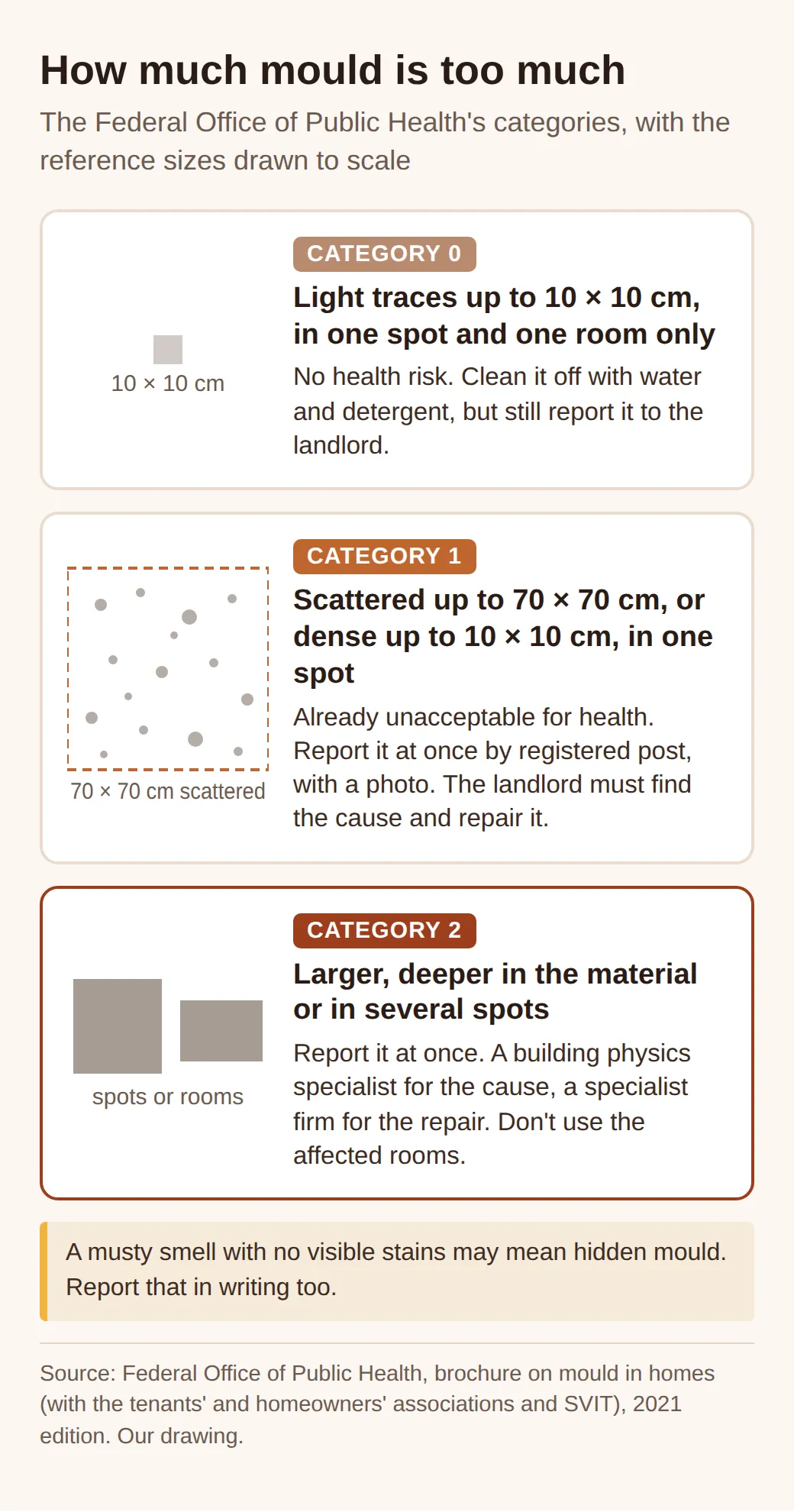
Category 0 traces, no more than 10 by 10 centimetres in a single spot, are no problem for your health or for the building: you can remove them with water and detergent, but you should still report them. From category 1 upwards, the FOPH regards the situation as unacceptable from a health-prevention point of view, and the landlord must find the cause and have it repaired properly. A musty smell with no visible stains should be reported too, because it can point to hidden mould.
For a rent reduction you need more than mould: it has to restrict your use of the apartment. A case from the Bellinzona area shows this. In 1994 a tenant of a 3-room apartment at CHF 1,100 a month had mould stains in two rooms because water was seeping in. He asked for 30%, the conciliation office gave him 20%, the district court 5% for five months: CHF 275 in all. The Civil Cassation Chamber upheld the 5% in its ruling of 25 April 1995 (in Italian): proving inconvenience isn't enough, the court said, it must also have prevented or restricted the use of the property. And proving that is up to the tenant, starting with a letter.
First step: report it in writing
As soon as you see mould, report it in writing to the landlord or the property manager. This isn't just prudent, it's a duty: tenants must report defects and are liable for the damage if they don't (art. 257g CO). If the mould spreads while you stay silent, the extra damage can end up on your bill.
The letter matters for your money too. The rent reduction runs "from the time when the landlord or lessor became aware of the defect until the defect is remedied" (art. 259d CO). A phone call is hard to date; a registered letter isn't. That's exactly what the FOPH recommends: a registered letter with a photo or a description, after which, it says, further investigation becomes the landlord's responsibility. Landlords and agencies in Ticino work in Italian, so here is a short sample in Italian. It says: since the date given, mould has formed in the bedroom, about 40 by 30 centimetres in the corner of the outside wall, and three photos are enclosed; please have the cause investigated and fixed by the deadline, or I will deposit future rent with the conciliation office; I reserve the right to ask for a rent reduction from receipt of this letter.
Raccomandata. Oggetto: muffa nell'appartamento di via [street], [floor]. Le segnalo che dal [date] si è formata della muffa nella camera da letto, nell'angolo della parete esterna, su circa 40 per 30 centimetri. Allego tre fotografie. Le chiedo di farne accertare la causa e di eliminarla entro il [date, for example 30 days from today]. Se il difetto non sarà eliminato entro questo termine, depositerò le pigioni future presso l'Ufficio di conciliazione competente (art. 259g CO). Mi riservo di chiedere una riduzione della pigione dal ricevimento di questa lettera.
Keep a copy, the dated photos and, if you can, the post office receipt. If the landlord answers verbally, ask them to confirm in writing what you agreed.
A landlord who doesn't react gains nothing by waiting. In a case the Court of Appeal decided in 2015, the landlord of restaurant premises in the Bellinzona area, told about mould on the upper floor, had only said to wait until the winter was over, without coming to look. In court she then argued that the report had come too late: the district court found that argument contrary to good faith, and on appeal the landlord failed to reopen the point (ruling of 23 October 2015, in Italian). That tenant got a 10% reduction, even though the mould was partly her fault. How much the tenant's share of the blame weighs almost always comes down to one thing: fresh air.
Airing the rooms: when the tenant is to blame
Many landlords' first answer is that the tenant doesn't air the place. Sometimes that's true. The FOPH brochure says what can be expected of the people living there: air at least three times a day by opening all windows and doors for 5 to 10 minutes so that a draught goes through; don't keep windows tilted open all day during the heating season; leave 10 centimetres between furniture and outside walls. In older, poorly insulated buildings, especially those from the 1960s and 1970s, it advises not putting off the heating and keeping rooms at 20 degrees. In winter, relative humidity should stay between 30 and 50%, and below 40% on very cold days: a hygrometer tells you where you stand.
If you do none of this, you risk paying. But the most instructive ruling on this point comes from Ticino, and it went against the landlord. In 1991 two tenants rent a detached house in the Lugano area for CHF 2,600 a month. From summer 1992, damp and a smell of mould appear on the first floor. In 1994 the tenants deposit the rent with the conciliation office in Massagno and ask for a 60% reduction. The court-appointed expert puts 80% of the blame on them because they air too little, and the district court rejects the whole claim: airing, it writes, is part of everyday life.
On appeal the picture changes. The Second Civil Chamber (ruling of 23 April 1996, in Italian) notes that the mould wasn't spread across the whole floor, as it would have been if stale air were the cause, but only near the roof. The roof's vapour barrier didn't meet SIA standards, and that type of roof needed more air exchange than usual. Nobody had told the tenants. Conclusion: the defect wasn't attributable to them. The fact that they aired less than normal, because one of them worked from home and suffered from a pollen allergy, only affected the percentage: 10% instead of the 25% the chamber usually granted for serious damp, from August 1992 until the expert report was served in September 1995.
Two practical lessons come out of this case. Where the mould sits matters: stains concentrated in one spot, like these near the roof, say more about the building than about the habits of the people living in it. And an expert's assumption isn't enough: the chamber dismissed the idea that the windows were always kept shut as unproven. To establish the cause, in short, someone has to prove it.
The expert report: who asks for it and who pays
Ticino has an expert designed for exactly these disputes: the municipal expert for rental properties (perito comunale degli immobili locativi). Every municipality appoints one, plus a deputy, to give advice and record findings on site, above all on damage and defects in rented homes. The expert must be independent of the municipal executive and know about building; articles 12 and 13 of the cantonal act implementing federal tenancy law (in Italian) say so.
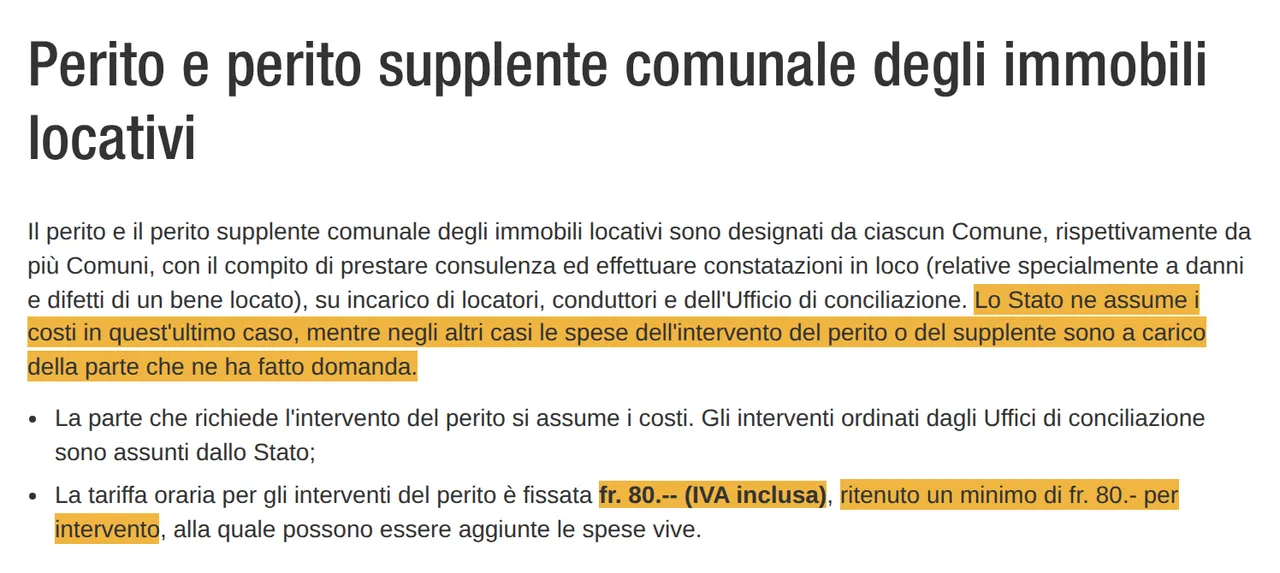
You can call in the expert, and so can the landlord or the conciliation office. According to the Ticino judiciary's page (in Italian), the rate is CHF 80 an hour including VAT, with a minimum of CHF 80 per visit plus out-of-pocket expenses, and whoever requests the visit pays. If the conciliation office orders it, the canton pays. The conciliation offices can give you the name of the expert for your municipality; the list is published every year in the cantonal Official Gazette.
The municipal expert's report is a neutral, dated document, and the tenants' association lists it among useful evidence, along with photos and witness statements. It has one limit, though: the expert records, but doesn't decide. In a case from the Mendrisiotto in 2000 (in Italian), the Court of Appeal disregarded the sentences in the report that were opinions rather than findings, because without photos or other evidence they could not bind the judge. When the cause of the mould is genuinely disputed, the FOPH advises the landlord to bring in a specialist in water damage and building physics. If it goes to court, the judge orders the expert report, as in the case of the detached house.
Once the cause is established, the question that matters most remains: how much is a mouldy wall worth in francs?
How much rent reduction for mould?
There's no table in the law. The Federal Supreme Court set out the method in BGE 130 III 504 (ruling in French): you compare the value of the apartment with and without the defect, and where the calculation is difficult, the judge decides on the basis of fairness, with common sense and experience of earlier cases. That's why earlier cases matter so much.
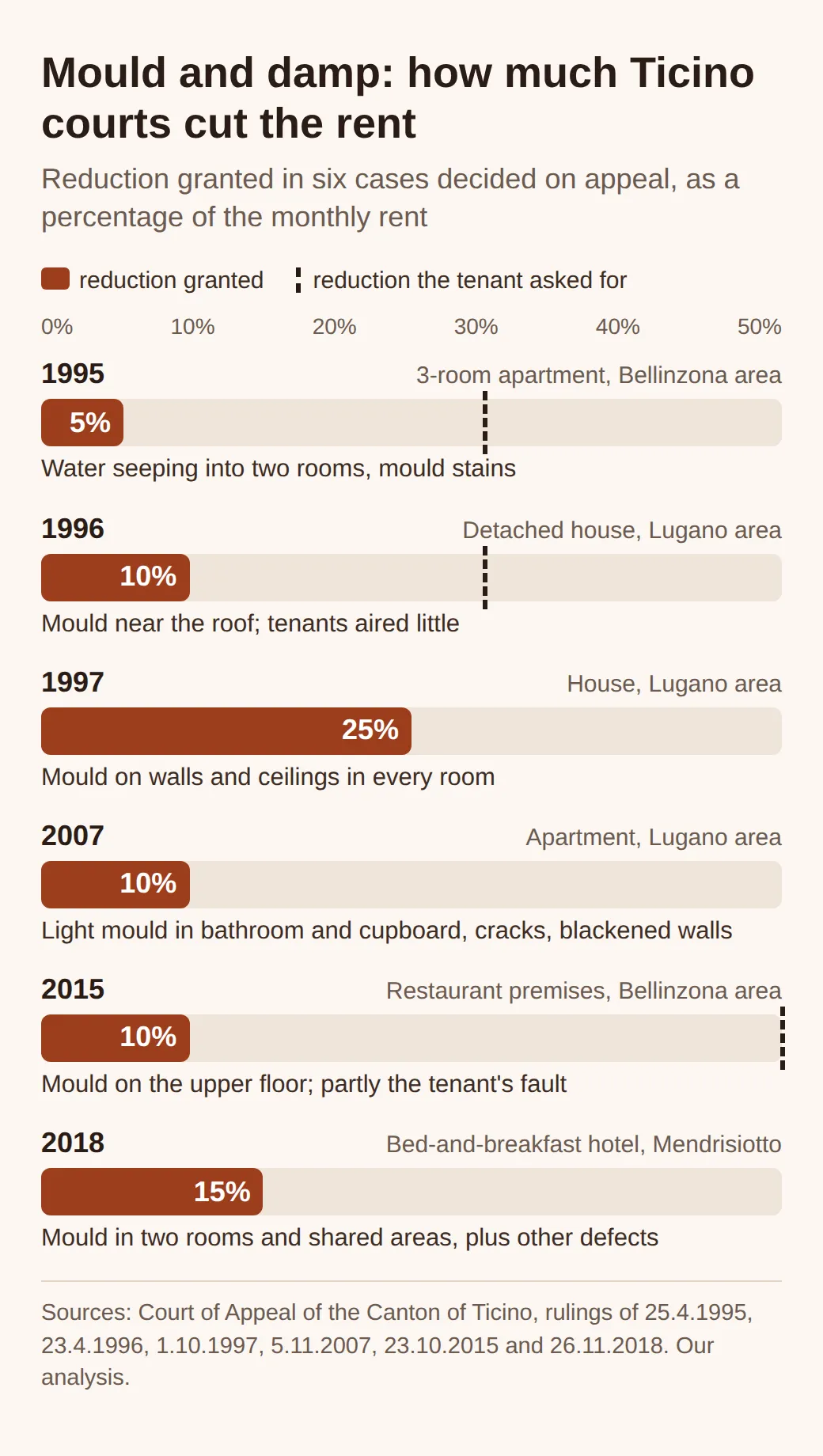
The Ticino Court of Appeal summed up the case law in a ruling of 26 November 2018 (in Italian): for water seepage, damp and mould, reductions range from 5% in mild cases to 40 to 50% in serious ones. In the Ticino cases we read, though, they stay between 5 and 25%. In a ruling of 5 November 2007 (in Italian) on an apartment in the Lugano area, the chamber granted 10% for light mould in the bathroom and a cupboard, cracks and blackened walls, and ordered the landlord to replaster and repaint throughout. It cited a case from Basel-Landschaft in which a little mould in two corners of one room, in a 4½-room apartment, was already worth 10%. The chamber granted 25% where damp compromised the habitability of the home.
Two things stand out in the chart. People who ask for a lot rarely get a lot: 30% asked and 5% granted in 1995, 50% and 10% in 2015. And the reduction only lasts as long as the defect, from the day you report it until the repair. On a rent of CHF 1,500, 10% comes to CHF 150 a month: an amount worth claiming, with the evidence in hand. You only get the reduction, though, if you take the right route.
Don't stop paying: deposit the rent instead
The most expensive mistake is withholding rent on your own. If you're behind on rent, the landlord can set you a deadline of at least 30 days and then give at least 30 days' notice to the end of a month (art. 257d CO). And notice given for unpaid rent isn't covered by the protection against termination during conciliation proceedings or in the three years after them (art. 271a para. 3 CO). The tenants' association for Italian-speaking Switzerland (Associazione Svizzera Inquilini, ASI) puts it bluntly in its fact sheet on defects (in Italian): stopping payment is always wrong.
A case from 1997 shows what it costs. The tenant of a house in the Lugano area, at CHF 1,200 a month, stops paying in October 1995 because of widespread mould on walls and ceilings, and offsets the rent against his ruined furniture. The district court sides with him: a 50% reduction, then 100%. The Civil Cassation Chamber (ruling of 1 October 1997, in Italian) finds those percentages arbitrary and brings them down to 25%. The upshot: the tenant owes CHF 3,000 plus interest, and his objection to the payment order is definitively set aside.
The correct route is to deposit the rent (art. 259g CO). It works in four steps:
- You ask the landlord in writing to fix the defect within a reasonable deadline and warn them that if they don't, you'll deposit the rent. The ASI gives 30 days as an example.
- If the deadline passes, you pay the rent not yet due to the conciliation office and tell the landlord in writing. If you pay rent in advance, the ASI advises paying between the 25th and the 28th of the previous month.
- Rent paid on deposit counts as paid: you're not in arrears.
- Within 30 days of the due date of the first deposited rent, you must take your claims to the conciliation office: repair, a reduction, damages if any. If you don't, the money goes to the landlord (art. 259h CO).
In Ticino, the rent is deposited with the conciliation office for your district (page in Italian). In Lugano, for example, the rent deposit account has no management fees and earns no interest. The conciliation procedure is free, as the FOPH also points out; we explain how the hearing works in our article on ending a lease in Ticino.
Ruined furniture, health and serious cases
The reduction makes up for an apartment that's worth less. Damage to your belongings is a separate item: the landlord pays for it "unless he can prove that he was not at fault" (art. 259e CO), so here the burden of proof is on the landlord. In the 1997 case the tenant only had a list signed by a witness, with no receipts or photos, and the court still awarded him CHF 2,400 for the things he had thrown away. With photos it would have been easier.
On health, the FOPH is clear: the more mould there is, the greater the risks. Moulds irritate the eyes, skin and airways, sometimes trigger allergies and, over time, chronic bronchitis and asthma. People with severe allergic asthma or a weakened immune system risk serious illness. For category 2, the FOPH advises closing the affected rooms and not using them, and never switching on a dehumidifier before the mould has been removed.
When mould makes the apartment unfit to live in or seriously restricts its use, and the landlord doesn't remove it within a reasonable time, the law even lets you terminate the lease with immediate effect (art. 259b CO). The ASI considers this possible where heavy damp makes the home unhealthy, but warns that the risks are considerable and that you should consult an expert first.
At the end of the lease: mould in the handover report
Mould comes up again on the day you hand back the keys. You must return the apartment "in a condition that accords with its contractually designated use" (art. 267 CO), and the landlord must inspect it and tell you straight away about any defects you're answerable for (art. 267a CO).
The Mendrisiotto case mentioned above shows how judges reason. The landlord was claiming more than CHF 12,000 for repairs and rent from the former tenant of a 4-room apartment. For mould behind a wardrobe, found only when the furniture was moved, he got nothing: it wasn't visible and could have been there from the start. For mould on the bathroom walls above the tiles, on the other hand, the court charged the tenant a quarter of the bill for anti-mould paint, CHF 63, because no tenant would have accepted a mouldy bathroom at the start. If you reported mould during the tenancy, with letters and photos, you arrive at the handover with proof that it wasn't your fault. For the rest, including the deposit, you'll find the rules in our article on the rent deposit in Ticino.
Before you sign: check the corners
The best moment to avoid a dispute is the viewing. Look at the corners of the outside walls, the bathroom ceiling, the edges of the windows and the back of built-in wardrobes; sniff the air in rooms that have been closed. If you see traces of mould or fresh paint, ask where they came from and what was done. The FOPH points out that a wall repainted with anti-mould paint, without removing the cause, isn't a proper repair.
If the mould is already there when you move in, your rights still apply to defects that were already there at handover (art. 258 CO). But have it written into the move-in report, with photos, and ask in writing for it to be removed, or have the municipal expert visit: a visit from CHF 80 upwards is worth more than any argument five years later. For advice on your own case, the ASI (in Italian) advises its members (membership costs CHF 120 for the first year), and the conciliation offices give free information to tenants and landlords alike.
If you're looking for a drier apartment, you'll find listings from across the canton on our page of apartments for rent in Ticino.
Common questions
Can I remove mould myself and send the bill to my landlord?
Small traces, yes, but at your own expense: cleaning them is part of regular maintenance. For anything more, the tenants' association advises against doing it yourself, because presenting the landlord with a fait accompli makes it harder to get your money back. The law only lets you have the defect fixed at the landlord's expense after you've reported it and set a deadline that the landlord lets pass, and only if the defect isn't serious.
Can my landlord end my lease because I reported mould?
Notice given because you asserted your rights in good faith can be contested at the conciliation office within 30 days. You're also protected during conciliation or court proceedings and for three years after proceedings the landlord largely lost or settled with you. That protection during and after proceedings doesn't apply, though, to notice given because you didn't pay the rent.
Do I need a mould test or a humidity measurement?
Usually not. The Federal Office of Public Health says that for visible mould a written description or a photo sent to the landlord is enough, and that measurements would only confirm the obvious. For hidden mould there is currently no reliable way to measure it. What you do need, if you and the landlord disagree, is to find the cause, and that's a job for an expert.
What if my rented apartment is in a condominium and the facade is the cause?
For you, nothing changes: your contract is with your landlord, and you assert your rights over defects against them. The landlord takes it up with the property manager and the other owners, who decide under the condominium regulations who repairs the facade. In the meantime, your rent reduction still runs from the day the landlord learned of the defect.
More from the blog
All posts
Rent deposit in Ticino 2026: limit, insurance and refund
Rent deposit in Ticino: three months' rent at most, a blocked account in your name within 10 days, what deposit insurance costs and the refund after a year.

Ancillary costs in Ticino rentals: what you really pay
Ancillary costs on a Ticino rental: which items you pay, advance payments or flat rate, what the yearly statement must show and how to dispute a high bill.

Renting a second home in Ticino: Lex Weber and tourist tax
Renting a second home in Ticino in 2026: the three-month rule, the 56 municipalities under Lex Weber, the tourist tax and what to check before you sign.