Ancillary costs in Ticino rentals: what you really pay
Before you pay
Your landlord can only charge you the ancillary costs listed one by one in your lease, and only for real costs tied to using the flat: heating, hot water, the caretaker, stair cleaning, lighting in the common areas. Repairs, mortgage interest and building insurance stay with the landlord. If you make advance payments, you get a statement at least once a year and you have the right to see the invoices.
This is not a small matter. After the 2023 rise in energy prices, the legal protection insurer AXA-ARAG handled about 20% more cases on ancillary costs from the start of 2024, nearly all about statements and disputed items. Many guides online describe other countries' rules. Here you get the Swiss rules, with the details that matter in Ticino.
What your landlord can charge
Only what the lease lists clearly. Article 257a of the Code of Obligations (CO) says ancillary costs, which the law calls accessory charges, are payable by the tenant "only where this has been specifically agreed". Anything the lease does not name is covered by the net rent, and the landlord cannot add it later with a simple letter.
A list tucked away in the general terms is not enough either. In its 2009 ruling BGE 135 III 591, the Federal Supreme Court held that the costs the tenant pays must be described clearly and precisely in the lease itself. General terms can only give details of items already named there. The Swiss German tenants' association, sister federation of Ticino's ASI, draws a practical rule from this: phrases like spese d'esercizio (operating costs) or spese usuali (usual costs) are too vague. If your lease says "heating and other operating costs", you pay for the heating and nothing else.
The second condition is about the kind of cost. For homes, CO art. 257b only allows the "actual outlays" for services tied to use, such as heating and hot water, and public charges that arise from using the property. The landlord cannot make a profit on them, and cannot make you pay for repairs and renovations: you already pay for those through the rent.
| Item | Usually chargeable, if in the lease | Not chargeable |
|---|---|---|
| Heating | Fuel, power for the burner, chimney sweep, periodic servicing | Repairing or replacing the boiler, depreciation |
| Caretaker and cleaning | Cleaning stairs and surroundings, small jobs | Flat viewings and handovers, repairs |
| Lift | Electricity, maintenance-only contract | Spare parts, repair contracts |
| Other | Water, sewage, lighting of common areas, garden, snow clearing, cable TV | Building insurance, taxes, street lighting |
The table sums up the tenants' association's list of allowed and disallowed costs, which also flags the grey areas: service contracts for systems such as air conditioning or alarms, for example, are disputed. Heating has rules of its own, and it is almost always the biggest item.
Heating: what goes into the bill
If your lease names heating, the landlord can charge all the costs of running it, even without listing them one by one. Article 5 of the federal ordinance on residential and commercial leases (OLAL in Italian, VMWG in German; there is no official English text) lists them: fuel and energy used, power for the burner and pumps, cleaning the boiler and chimney, periodic servicing of the system and the oil tank, meter reading, maintenance, insurance of the heating system alone, and admin work. The same applies to central hot water, including descaling the water heater.
Under OLAL art. 6, repairing and renewing the systems, interest and depreciation are excluded. There is one exception: if the heat comes from an outside plant, such as a district heating network, the landlord can charge what they actually pay the supplier (art. 6a). The heating of an empty flat, on the other hand, is not passed on to the other tenants: the landlord pays for it. If it was only heated enough to stop it freezing and there are no individual meters, the landlord usually pays just part of that flat's share: a third in a building with two or three flats, half with four to eight, two thirds in larger buildings (art. 7).
With oil heating, the bill depends on how much oil was in the tank. OLAL art. 8 gives you the right to ask for the stock at the start and the end of the period. A correct statement starts from the opening stock, adds the purchases and subtracts the closing stock. Without these three numbers, you cannot tell whether you are paying for the oil that was burned or the oil still sitting in the cellar.
The waste fee in Ticino
In Ticino, the basic waste fee does not usually go through your landlord. The cantonal law implementing the federal Environmental Protection Act (art. 18a) puts it on the people living in the municipality, whether or not they use the services. Non-recyclable household waste is then paid for through the official bags, the so-called bag fee.
Lugano is a good example. The City bills the basic fee to each household based on the residents' register: for 2026, 50 francs for a single person and 100 francs for two or more people, with no reductions. The amounts vary from one municipality to the next, but the principle is the one in the cantonal law.
So if your statement has an item called rifiuti (waste) or smaltimento (disposal), ask what it covers. It may be a service for the building that your lease provides for, but it must not be the same fee the municipality has already billed you. In any case, the Swiss German tenants' association says that basic fees tied to the property's value rather than to use cannot be charged. Once it is clear what can be charged, the next question is how you pay.
Advance payments or a flat rate: two different systems
The difference decides whether you get a bill at the end of the year. OLAL art. 4 provides for two systems. With advance payments (payments on account), you pay a provisional amount each month and the landlord must draw up a statement of the real costs at least once a year: if you paid too much, you get the difference back; if you paid too little, you are asked for an additional payment. With a flat rate, you pay a fixed amount and get no statements, no refunds and no extra bills. The flat rate, though, must be based on the average costs over three years.
The Federal Office for Housing (FOH) names advance payments with a yearly statement as the most common form; the period often runs from July to June. If you think your flat rate is too high, you can ask the landlord how it was calculated. And if your lease mentions ancillary costs without saying whether they are advance payments or a flat rate, many lawyers assume advance payments, but according to the tenants' association you can argue for the reading that favours you, because an unclear contract is read against whoever wrote it.
Advance payments bring one more item: the admin fee for preparing the statement. OLAL art. 4 allows it based on the actual work or at the usual rates. It is often a percentage of the total. The tenants' association says you should not accept more than 2 or 3%, and cites cantonal decisions and an FOH notice stating that usual percentages go up to 3% at most.
What the statement must show
A proper statement lets you redo the sums yourself. The law sets no template, but the tenants' association says what it must include: the period, each item with its total cost for the building, the key used to split that total between the flats, your share, the advance payments you made and the balance. A single total for "water, lighting and caretaker" is not enough.
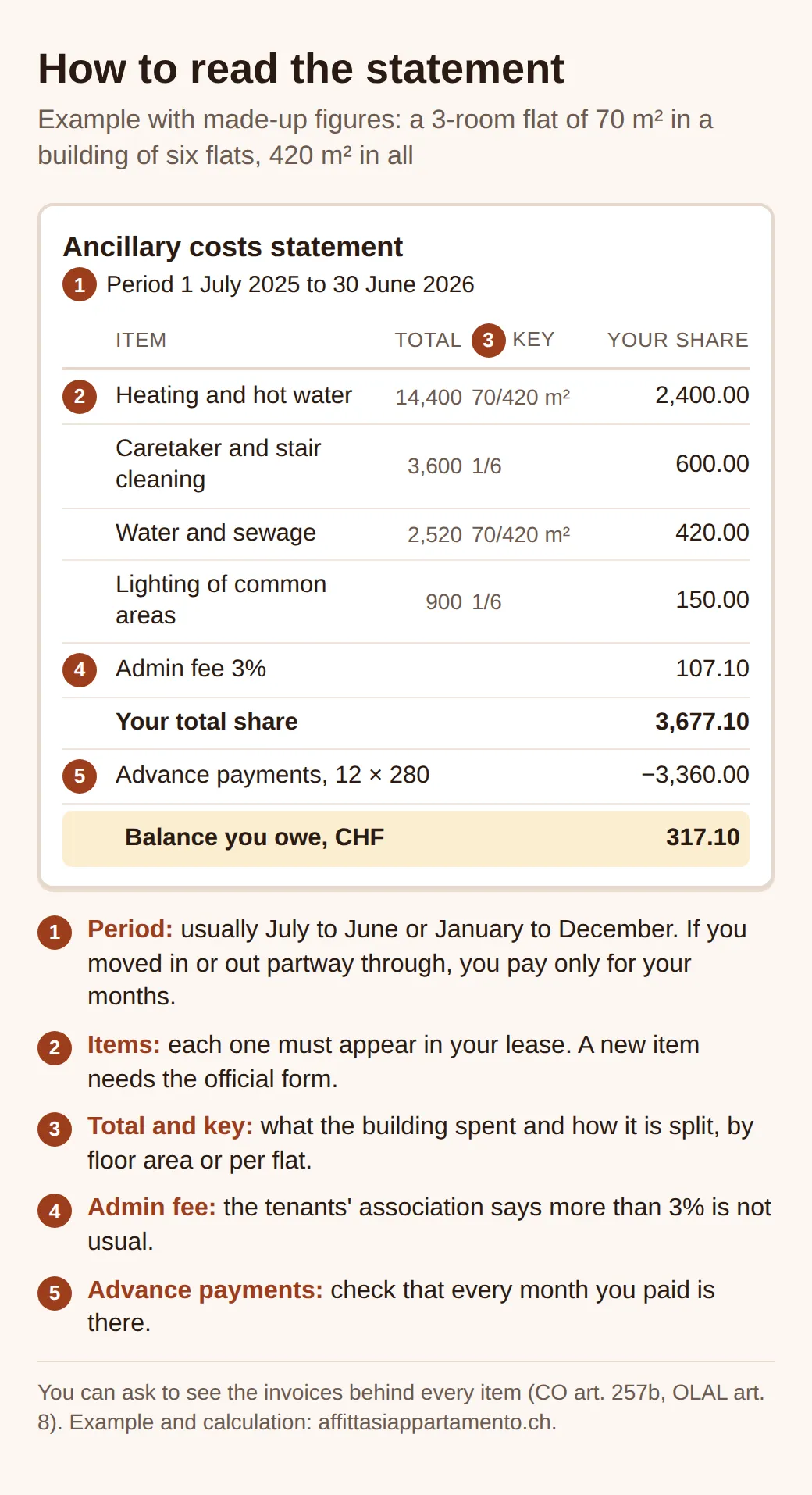
Take your lease and compare the items one by one: each must appear there too, ideally under the same name. Then compare the statement with last year's. Higher heating costs after a cold winter or a rise in energy prices are normal. A new item or a different allocation key is not, because the landlord can only introduce them with the official form. If the detail is missing, ask for it: for heating and hot water, OLAL art. 8 says that the yearly bill, if it does not already include the detailed statement, must state explicitly that you can ask for one.
Your right to see the invoices
Your landlord must show you the supporting documents if you ask: CO art. 257b para. 2 says so, and the law sets no deadline. Many statements say that objections must be made within 30 days. According to the tenants' association, this deadline has no legal basis: you can still ask to see the invoices later, although it is better not to wait too long.
In practice, the association says the landlord can ask you to look at the documents in their office, as long as it is not far from where you live. If you want copies, you usually pay for them. Look closely at vague items such as servizi (services) or abbonamenti (subscriptions). A service contract that also covers repairs and spare parts cannot go entirely into the ancillary costs: the repair part is maintenance, and the landlord pays for it.
A registered letter is all it takes:
Dear Sir or Madam, I have received the ancillary costs statement for the period from [...] to [...] for the flat at [...]. Under CO art. 257b para. 2 and OLAL art. 8, I would like to see the original invoices for the items [...], the allocation key used and, for the oil heating, the stock at the start and end of the period. Until then, I will pay the part of the balance I do not dispute. Yours faithfully.
The invoices often explain everything. Sometimes, though, the problem is not a wrong item but the final figure.
A surprise additional bill: do you have to pay?
As a rule, yes, even if it is very high. If the items are in the lease and the costs are real, the advance payment was only an advance, not a cap. The Federal Supreme Court said so in its ruling BGE 132 III 24 of 31 August 2005.
The case concerned a couple who had rented a 5-room flat since 1997 for a net rent of 2,950 francs a month, with an advance payment of 150 francs for heating, hot water, the caretaker, the lift, water, common electricity and other items. Every year, the real costs were more than double the advance payments. The couple paid, then claimed back 10,143 francs for five periods: the part of the costs more than 20% above the advances. The Federal Supreme Court said no: anyone who signs a lease with advance payments and a statement knows they will pay for what is used, and without an assurance from the landlord they cannot count on the advance being enough.
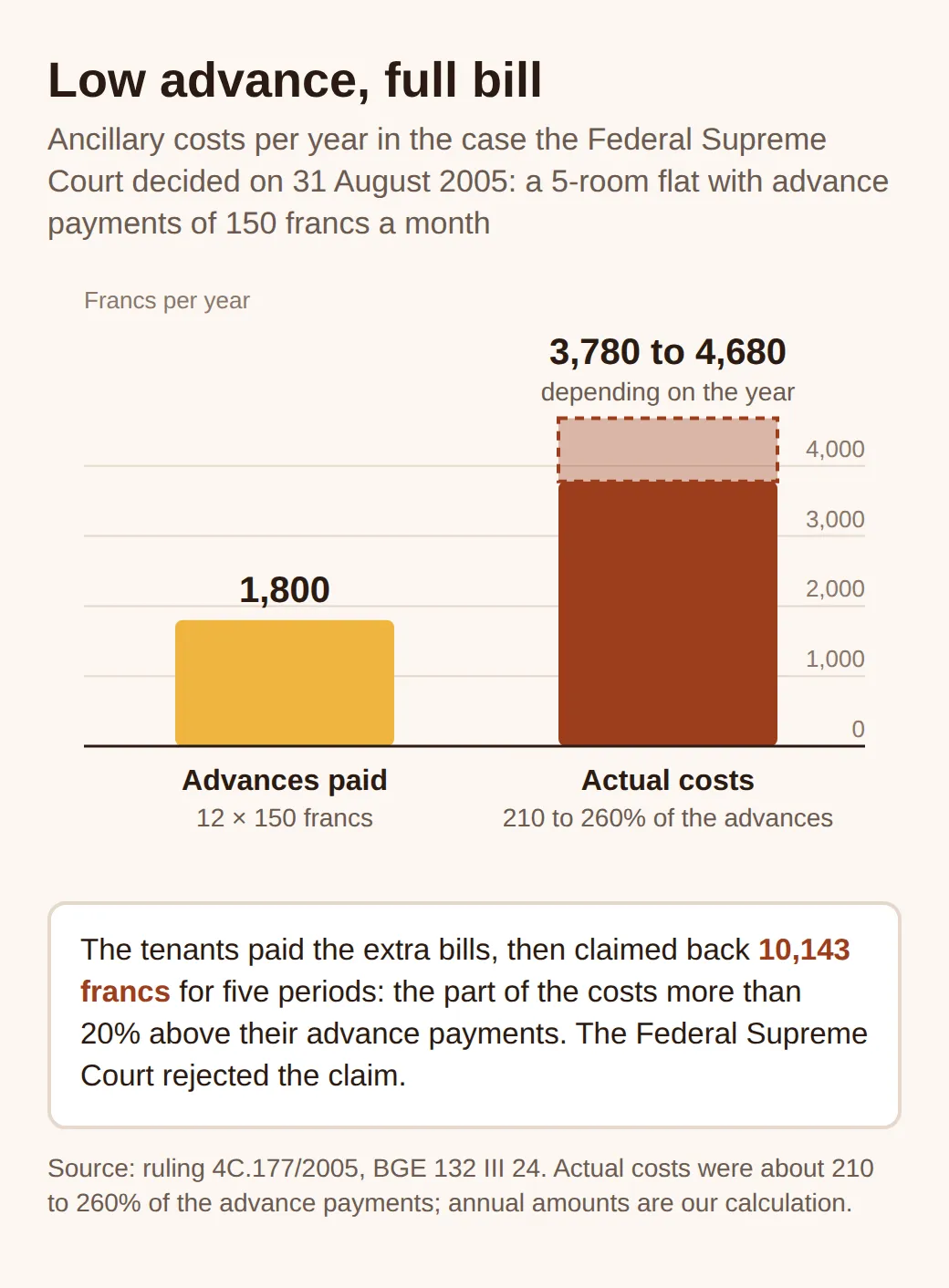
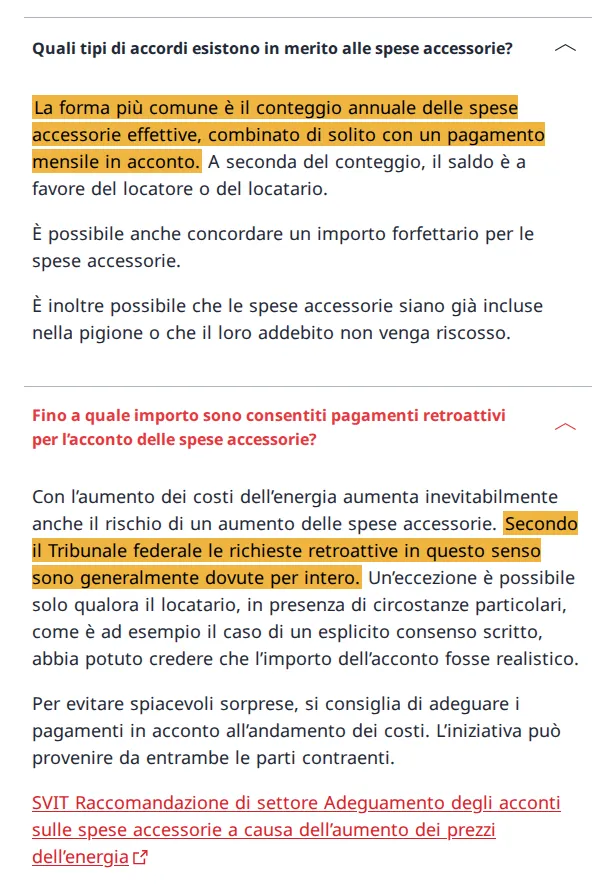
The same ruling leaves a door open: if the landlord assured you that the advance covered the costs, things are different. The FOH sums it up like this, giving explicit written consent as an example:
It pays to think about this before you sign. Ask for the statements of the last few years for the flat, or at least the total costs paid by the previous tenant: if the advance on offer is much lower, you already know what is coming. You can see what ancillary costs look like in Lugano listings in our guide to rents in Lugano. And if you are worried about a big additional bill, you can ask to pay a higher advance: according to the tenants' association you lose nothing, because any surplus comes back to you at the end of the year.
New costs during the tenancy
Your landlord cannot add an item partway through the lease with a letter. Introducing new ancillary costs, raising a flat rate or changing the allocation key is a change to the lease to your disadvantage. CO art. 269d para. 3 applies the same rules as for a rent increase: the official form, reasons given, and notice at least ten days before the notice period begins. Without the form, the change is void. In Ticino, the cantonal courts point out that the forms of the Department of Institutions must be used.
If the form arrives, you have 30 days to challenge the change at the conciliation office (CO art. 270b). A letter that suggests raising your advance payment and asks you to sign to accept is a different matter: according to the tenants' association, and also the recommendation of the property managers' association SVIT, it is only an offer. If you don't sign, nothing changes. As with a notice to quit from the landlord, in Ticino a notice without the prescribed form is void: our guide to ending a lease in Ticino covers this.
If you disagree with the statement
Pay the part you don't dispute and challenge the rest in writing. This is the most delicate point: ancillary costs are among the sums for which the landlord can give you 30 days to pay and then terminate your lease if you don't (CO art. 257d). According to the tenants' association, if you refuse in good faith to pay an amount you have reason to think is wrong, you are protected, but the undisputed part must be paid all the same. If you receive a payment demand threatening termination, get advice straight away.
In your letter, list the items you do not accept and why: an item not in the lease, a repair billed as an ancillary cost, the wrong key, an admin fee that is too high. Ask for a corrected statement by a set date. Time is on the landlord's side too: according to the tenants' association, they can claim an additional payment up to five years after the end of the period (CO art. 128), so even a statement that arrives late should be taken seriously.
If the letter does not settle it, the next step is the rent conciliation office (Ufficio di conciliazione in materia di locazione) for your district. Ticino's courts list conguagli spese accessorie (additional bills for ancillary costs) among the disputes that go there. In rental disputes, conciliation costs you no court fees (CPC art. 113), and for sums up to 2,000 francs whoever files the claim can ask the office to decide the case itself (CPC art. 212). The offices must also advise both sides outside a dispute.
For advice before you write, the ASI's InfoAlloggio service, run by the tenants' association of Italian-speaking Switzerland, answers on 091 966 82 72 on Mondays and Tuesdays from 9.30 to 12.30 and on Thursdays from 10 to 12, and also takes general questions from non-members. In 2024 it took 4,350 calls, 180 of them about statements, according to its annual report. To have your own statement checked, you need your documents and an appointment at one of the regional offices. Joining the ASI is optional but recommended: the membership fee is 120 francs for the first year and 70 francs for each renewal, and new members commit for three years.
When the next statement arrives
Keep your lease, past statements and receipts for your advance payments in one folder. When the envelope arrives, make three comparisons: the items on the statement against the items in the lease, the total against last year's, and the advances recorded against the advances you paid. If something doesn't add up, ask for the invoices before paying the disputed balance, and pay the rest in the meantime. Ancillary costs also matter when you sign a new lease: according to the tenants' association, the three months' rent for the rental deposit is calculated including the advance payments or the flat rate.
If you are looking for a flat, check the gross rent in listings and always ask what the last additional bill was. You'll find the listings on our page of apartments for rent in Ticino.
For Bellinzona and the surrounding area, the listings are gathered here.
Common questions
Are electricity and the Serafe radio and TV fee part of ancillary costs?
As a rule, no. The electricity you use in your flat is billed to you by the supplier, based on your own meter. The radio and TV fee collected by Serafe is not the same as the building's basic cable TV subscription: only the cable subscription can be an ancillary cost, and only if your lease says so.
If I move out mid-year, when do I get my ancillary costs statement?
At the end of the period, like the other tenants: before then the landlord does not have all the invoices. You only pay the share for the months you lived there. For heating, the months do not all count the same, because more is used in winter, and the calculation has to reflect that.
Can my landlord change how ancillary costs are split between flats?
Not on their own and not at any time. Switching from a share per flat to a split by floor area, for example, is a change to your lease. It has to be notified on the official form for the next termination date, and you can challenge it at the conciliation office within 30 days.
What can I do if the ancillary costs statement never arrives?
The law requires a statement at least once a year. The Swiss German tenants' association says it should arrive within about six months of the end of the period. If it is very late, you can ask for it by registered letter and, if needed, turn to the conciliation office.
More from the blog
All posts
Where is rent cheapest in Ticino? The five regions compared
Where rent is cheapest in Ticino: prices in the five regions from cantonal data, with train times and travelcard costs to Lugano.
Ending your lease in Ticino: notice period and forms 2026
How to end a rental lease in Ticino: three months' notice, a signed letter, the landlord's official form, 30 days to contest and a replacement tenant.

Renting a second home in Ticino: Lex Weber and tourist tax
Renting a second home in Ticino in 2026: the three-month rule, the 56 municipalities under Lex Weber, the tourist tax and what to check before you sign.