Where is rent cheapest in Ticino? The five regions compared

The short answer
The regions of Ticino where rent is cheapest are the Tre Valli (the valleys of Leventina, Blenio and Riviera) and the Mendrisiotto. The most expensive is the Luganese, the area around Lugano, followed by the Locarnese. In 2024 listings, an 80 m² apartment cost a median of about CHF 1,260 a month in the Mendrisiotto, 1,330 in the Bellinzonese and 1,600 in the Luganese.
The lowest price isn't the whole story, though. If you live in Chiasso or Biasca and work in Lugano, you also pay for the train, and you spend time on it every day. So below, next to the rents, you'll find the journey times from the official timetable and the price of the Arcobaleno travelcard for each route. In some cases the saving disappears; in others, CHF 270 to 340 a month remains.
The five regions compared
The most complete data on rents by region comes from the cantonal housing observatory (Osservatorio cantonale sull'alloggio). Its October 2025 update report (in Italian), written by SUPSI, the University of Applied Sciences and Arts of Southern Switzerland, for the cantonal Department of Health and Social Affairs, looks at two different markets. The first is what's on offer: the listings published in 2024, the closest figure to what you'll find if you're looking for a home now. The second is what households actually pay under their current leases, as collected by the Federal Statistical Office up to 2023.
The report gives everything in francs per square metre a year. To make that easier to read, we converted the medians into a monthly rent for 80 m²: the figure per square metre multiplied by 80 and divided by 12. Eighty square metres is the low end of the average floor area in listings, which the report puts at between 80 and 95.
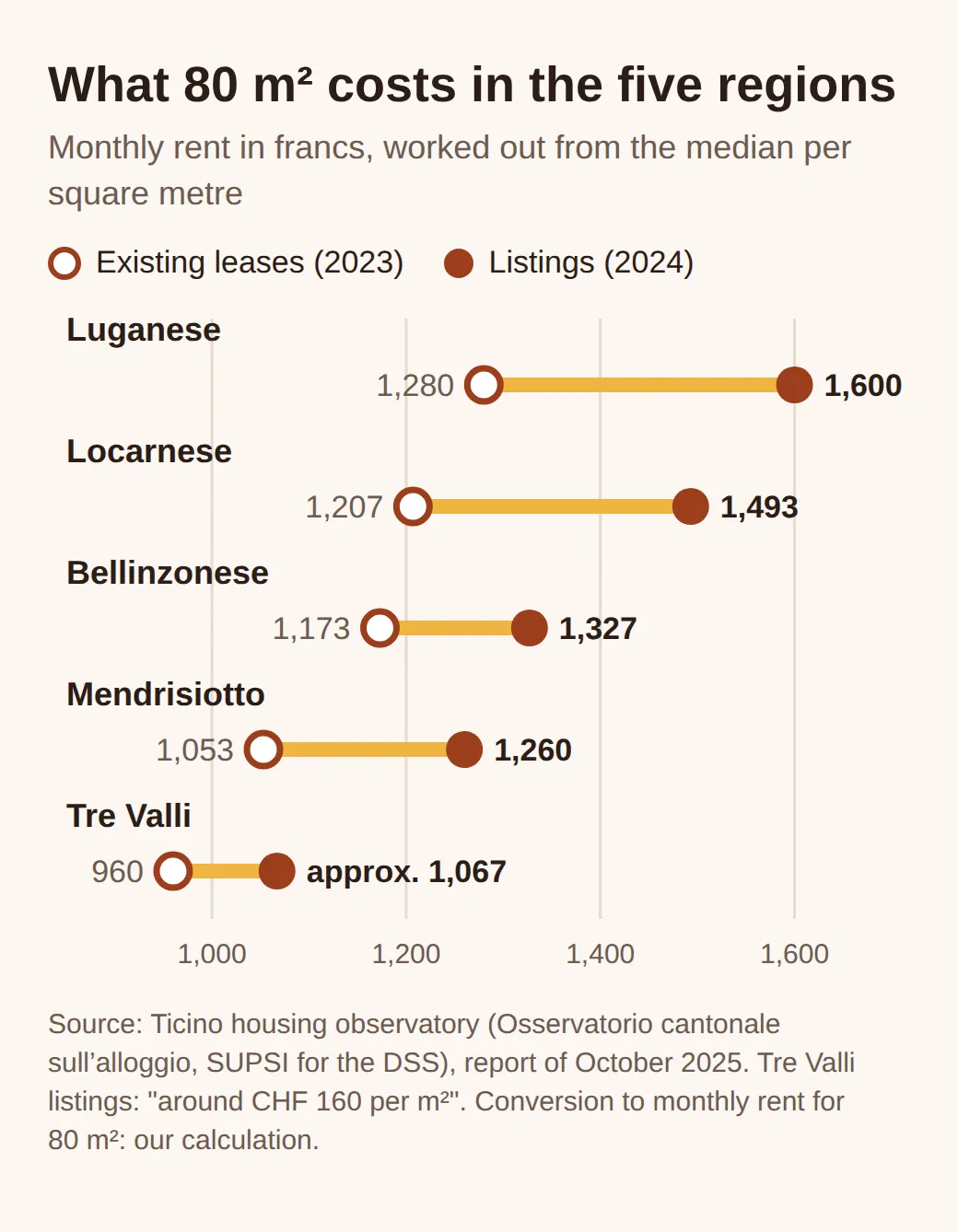
The ranking is the same in both markets. The Luganese leads with CHF 240 per m² in listings and 192 under existing leases. Next comes the Locarnese, at 224 and 181, then the Bellinzonese at 199 and 176, and the Mendrisiotto at 189 and 158. The Tre Valli remain the cheapest: for listings the report puts them at "around 160" francs, and for existing leases at 144.
For the same apartment, the gap between the most expensive region and the cheapest is about CHF 530 a month. Between the Luganese and the Mendrisiotto, which are close together and well connected, the gap is about CHF 340. That's the margin to work with, but first it helps to understand why the two sets of figures are so far apart.
Why new tenants pay more than existing ones
In every region, listings cost more than existing leases: 25% more in the Luganese, about 20% in the Mendrisiotto, 13% in the Bellinzonese. The two series aren't from the same year or the same source, so the gap is only a guide. The direction is clear, though: someone who has lived in the same apartment for years often pays less than you will if you sign today.
Ticino's statistics office (Ustat) explained the difference in a 2022 article on listings data (in Italian). Listings measure the apartments that are available at a given moment, and they change quickly. Official statistics measure the homes people live in, and they move much more slowly. Ustat also points out that the same listing can appear several times, and that some stay online after the apartment has been let.
The Ustat table of average rents by canton shows the other side. In 2024 the average net rent of occupied homes in Ticino was CHF 1,245 a month, against 1,485 across Switzerland. A 3-room home cost CHF 1,249 on average, a 4-room home 1,472, all figures excluding ancillary costs and heating.
For a realistic budget, then, start from the listings figures. The observatory's report doesn't say whether they include ancillary costs, so always ask about those separately: when you compare two apartments, they can change the result. And look at how many apartments are vacant too, because where there's plenty on offer, you have more room to negotiate.
Where the most apartments stand empty
On 1 June 2025 Ticino had 4,936 empty homes, 1.92% of the total, according to Ustat's overview of construction and housing (in Italian). By 1 June 2026 the rate had fallen further, to 1.78%, with 4,621 empty homes (Ustat table). That's still almost twice the Swiss average, which the Federal Statistical Office put at 0.93% on the same day.
The differences between towns are large. In 2025 Chiasso had a vacancy rate of 7.58%, Mendrisio 3.03%, Bellinzona 2.27%, Lugano 2.08% and Locarno 1.75%. Among the urban centres, the lowest figure was Gambarogno's, at 0.61%. Where many apartments stay empty, you have more choice and more room to negotiate on price.
Municipality by municipality, in listings
The observatory's report also publishes the medians for sixteen municipalities with a large number of listings. We converted them the same way, for 80 m² a month:
| Municipality | CHF per m² a year (2024) | 80 m² a month |
|---|---|---|
| Paradiso | 278 | 1,853 |
| Collina d'Oro | 256.5 | 1,710 |
| Ascona | 249.5 | 1,663 |
| Lugano | 243 | 1,620 |
| Massagno | 243 | 1,620 |
| Minusio | 228 | 1,520 |
| Locarno | 225 | 1,500 |
| Caslano | 216 | 1,440 |
| Agno | 203 | 1,353 |
| Bellinzona | 200 | 1,333 |
| Mendrisio | 200 | 1,333 |
| Stabio | 188 | 1,253 |
| Vacallo | 180.5 | 1,203 |
| Chiasso | 180 | 1,200 |
| Balerna | 178.5 | 1,190 |
| Morbio Inferiore | 165.5 | 1,103 |
Two things stand out. First, the most expensive municipalities aren't the towns but the ones around Lake Lugano, plus Ascona. Second, the five cheapest municipalities on the list are all in the Mendrisiotto, followed by Mendrisio and Bellinzona, which are tied. The report gives no figures for smaller municipalities, and some rows rest on few observations: Morbio Inferiore on 92 listings, Lugano on 2,464. For the valleys, only the regional figure is available. But a low rent is only worth something if the commute doesn't eat it up.
What the commute costs
In Ticino, buses and regional trains all use a single fare system, the Arcobaleno fare network, and the price of a travelcard depends on the number of zones you cross. From 13 December 2026, with the timetable change, Arcobaleno fares (in Italian) go up: the adult monthly travelcard in 2nd class rises from CHF 146 to 149 for four zones, and from 237 to 242 for eight zones or more, which covers the whole of Ticino. Our calculations use the new prices, which apply to every travelcard starting on or after 13 December 2026.
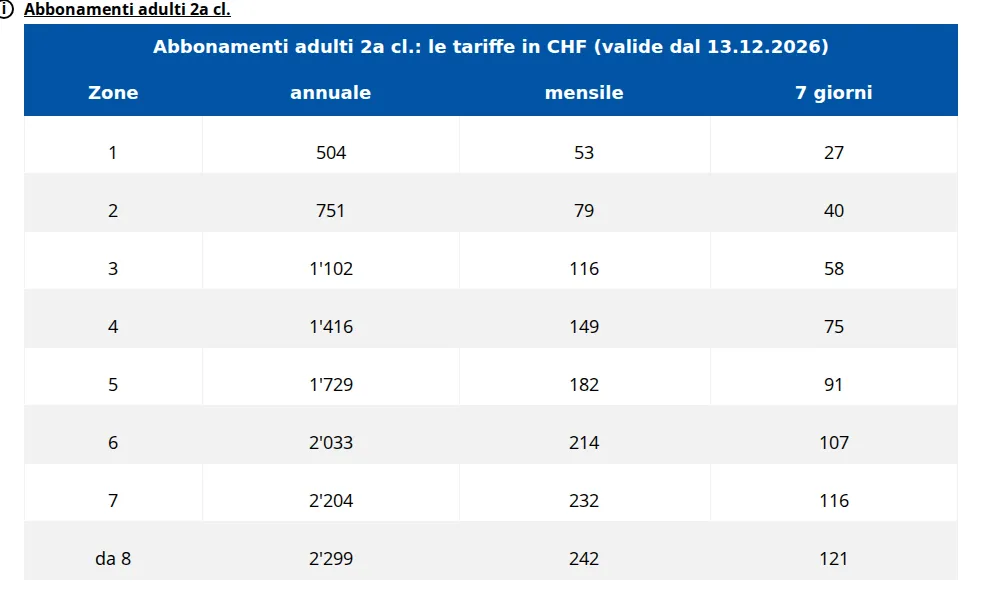
We took the zones for each route from the Arcobaleno fare calculator. From Chiasso or Mendrisio to Lugano you need four zones, from Bellinzona five, from Biasca six, from Locarno seven. From Faido and Airolo you need the travelcard for the whole canton. From Caslano, Ponte Tresa or Tesserete, two zones are enough.
The journey times come from the official 2026 timetable: table 631 for the line from Airolo to Chiasso, 632 for Locarno and 635 for the Lugano-Ponte Tresa railway. We looked at weekday morning departures between 6 and 9 am. The 2027 timetable, in force from 13 December 2026, may shift a few minutes. Put rent and travelcard together, and this is how it works out if you work in Lugano:
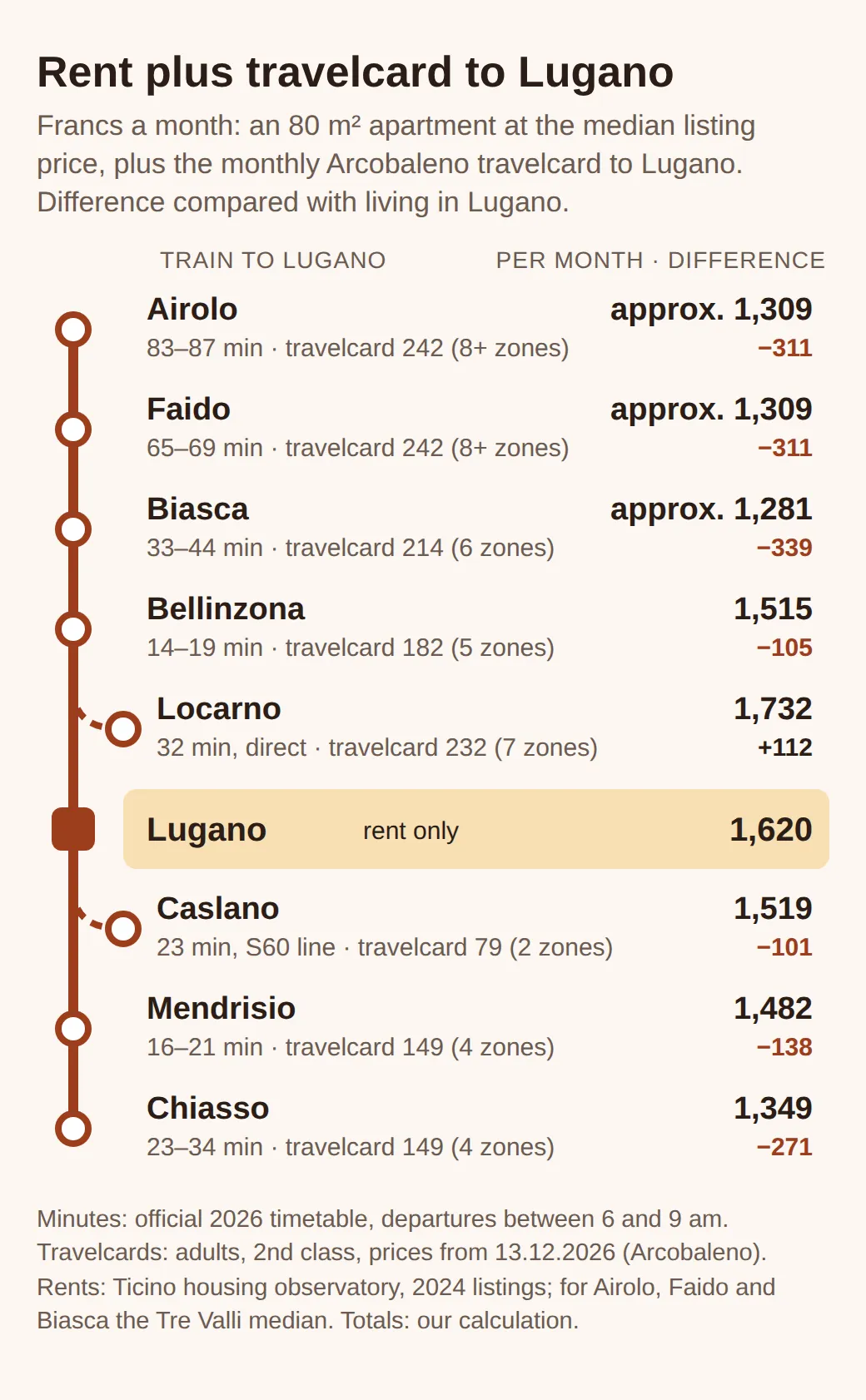
The calculation rests on a simple assumption: if you live in Lugano, you don't buy a travelcard at all. If you'd take the bus in town anyway, bear in mind that a travelcard for one zone costs CHF 53 a month, and the advantage of living outside grows by that amount. Now let's take the regions one by one.
Region by region
Mendrisiotto: the saving closest to Lugano
This is the option that holds up best in the comparison. Chiasso, at CHF 1,200 for 80 m², stays CHF 271 a month below Lugano even after you've paid for the travelcard. The RE80 train gets you to Lugano in 23–24 minutes, the S10 in 30–34. Mendrisio is more expensive, at CHF 1,333, but closer: 16–21 minutes by train, and a net advantage of CHF 138. Both need a four-zone travelcard.
Chiasso also has the highest vacancy rate of any town in Ticino, 7.58% in 2025. Under existing leases it cost CHF 146 per m² in 2023, the lowest figure among the twelve municipalities the report lists for that market. Around it, Balerna, Vacallo and Morbio Inferiore come in at roughly CHF 1,100 to 1,200 a month for 80 m², but from there you'll often need a bus to the station: check the zones in the fare calculator before you sign.
Bellinzonese: the cantonal capital, a quarter of an hour away
Bellinzona costs the same as Mendrisio in listings, CHF 1,333 for 80 m², and it's very close to Lugano thanks to the Ceneri Base Tunnel: 14 minutes on an InterCity, 19 on the S10. The five-zone travelcard costs CHF 182, though, and the net advantage drops to CHF 105 a month. From Giubiasco, it's the same number of zones.
The sums change if you work in Bellinzona, where the cantonal administration is based. Then the right comparison is with the valleys to the north: the S10 takes 14 minutes from Biasca to Bellinzona, and three zones are enough, at CHF 116 a month. From Locarno, the S20 gets there in 26 minutes, with four zones.
Locarnese: you pay for the lake
The Locarnese is the second most expensive region in the canton, and if you live there and work in Lugano, you spend more. Locarno costs CHF 1,500 for 80 m² in listings, only 120 less than Lugano, and the seven-zone travelcard costs CHF 232. The result: CHF 112 a month more than living in Lugano, with a direct RE80 train taking 32 minutes. Minusio and Ascona, at CHF 1,520 and 1,663, are more expensive still.
The Locarnese makes sense if your job is there, or if you commute to Bellinzona. If you're after lower prices in the region, you'd look at the Maggia valley (Vallemaggia), but the report doesn't publish separate figures for the Locarnese valleys. The transport links, though, are clear: bus 315 runs every 30 minutes and takes you from Maggia to Locarno station in 34 minutes, with a two-zone travelcard, and from Cevio in 50 minutes, with three zones.
Tre Valli: low rents, long days
Leventina, Blenio and Riviera have the lowest rents in Ticino: about CHF 1,067 a month for 80 m² in listings, 960 under existing leases. The report gives a single figure for the whole region, and under existing leases Biasca costs more than the valleys' average, CHF 161 per m² against 144. So figures for individual places are estimates.
On paper, the saving here is the biggest: from Biasca, even with the six-zone travelcard at CHF 214, you spend about CHF 339 a month less than in Lugano. The real price is time. Biasca to Lugano usually takes 40 minutes on the S10, Faido to Lugano 65–69, Airolo to Lugano 83–87: from Faido, that's more than two hours a day there and back. From the Blenio valley you also need the bus, which takes 23–25 minutes from Acquarossa to Biasca station.
If you work in Biasca or Bellinzona, or work from home a few days a week, the Tre Valli offer the biggest saving in the canton. For a daily commuter to Lugano, much less so.
The Luganese outside the city
Within the Luganese the differences are wide, and the municipalities right next to the city aren't necessarily cheaper: Massagno costs the same as Lugano, Paradiso and Collina d'Oro more. You'll do better looking along the Lugano-Ponte Tresa railway, which on weekdays runs every 15 minutes for most of the day. From Caslano, at CHF 1,440 for 80 m², you reach Lugano in 23 minutes with two zones at CHF 79: an advantage of about CHF 101 a month. Agno, at CHF 1,353, is on the same line.
For prices within the city, you'll find the details in our article on rents in Lugano.
How to choose: run the numbers
The method is always the same, and it works just as well for municipalities not listed here. Take the rent from a real listing, ancillary costs included. Add the travelcard for the zones you need, looking up the route in the Arcobaleno calculator. Compare the total with a similar apartment close to work. Then decide what the travel time is worth to you: 30 minutes each way adds up to five hours a week.
What the price doesn't tell you counts too. In a town with lots of empty apartments, such as Chiasso or Mendrisio, you have room to negotiate. Your municipality or your employer may pay part of the travelcard. And the first cost of moving comes before the first month's rent: the deposit, up to three months' rent, which is worth planning for using the rules in our article on the rent deposit.
Once you've chosen your region, look at what's available now: you'll find listings from across the canton on our page of apartments for rent in Ticino.
Common questions
Will my municipality pay part of my Arcobaleno travelcard?
Often, yes. According to the Arcobaleno fare network, many municipalities in Ticino and the Moesa region contribute towards the annual travelcard; each municipality sets its own amounts and conditions. Your employer can help too: with the Arcobaleno company travelcard, the employer pays at least 15% and the fare network adds another 15%, as long as at least five of the company's employees take part. Ask both before you buy.
Is an annual or a monthly Arcobaleno travelcard better value?
It depends on how many months you use it. Arcobaleno says that for adults the monthly travelcard only pays off for periods of less than nine and a half months. At the fares in force from 13 December 2026, four zones cost CHF 1,416 a year, against CHF 1,788 for twelve monthly travelcards.
Are rents in Ticino still going up?
In listings, yes. The cantonal median rose from about CHF 206 per square metre a year in 2022 to 218 in 2024, according to the cantonal housing observatory. Under existing leases, rents rise more slowly: in the Luganese, from CHF 187 to 192 between 2019 and 2023.
How much does a travelcard cost for young people in Ticino?
If you're at least 6 and not yet 25, you pay the youth fare, which applies in 2nd class. From 13 December 2026, a monthly travelcard for four zones costs CHF 106 instead of 149, and for six zones CHF 152 instead of 214. With a cheaper travelcard, living further out pays off even more.
More from the blog
All posts
Ancillary costs in Ticino rentals: what you really pay
Ancillary costs on a Ticino rental: which items you pay, advance payments or flat rate, what the yearly statement must show and how to dispute a high bill.

Renting a second home in Ticino: Lex Weber and tourist tax
Renting a second home in Ticino in 2026: the three-month rule, the 56 municipalities under Lex Weber, the tourist tax and what to check before you sign.
Ending your lease in Ticino: notice period and forms 2026
How to end a rental lease in Ticino: three months' notice, a signed letter, the landlord's official form, 30 days to contest and a replacement tenant.