Ending your lease in Ticino: notice period and forms 2026

The short answer
In Ticino you end an open-ended rental lease with three months' notice, for the termination date written in your contract or, if there is none, the date set by local custom or the end of a three-month period of the lease. If you are the one giving notice, a signed letter that arrives before those three months begin is enough. If your landlord gives notice, they must use the canton's official form or the notice is void, and you have 30 days to contest it.
These rules come from the Swiss Code of Obligations (CO) and are the same across Switzerland. Ticino adds a few things of its own: a cantonal form with its own required content, eleven conciliation offices split by municipality and, as federal statistics show, rent disputes that end in a settlement less often here than on average across Switzerland. Below you'll find the dates to mark, what to write, how to read the form if you receive one, and how to leave early by finding a replacement tenant.
How much notice do you need in Ticino?
Three months, expiring on a specific date. For homes, art. 266c CO sets three months' notice "expiring on a date fixed by local custom or, in the absence of such custom, at the end of a three-month period of the lease".
Your contract comes before the law, though. Under art. 266a CO, the parties can agree a longer notice period or different termination dates, and what is written there applies. Open your lease and look for two things: the notice period in months and the dates on which you can end it.
What about local custom? We found no official list of customary termination dates for Ticino. It is not in the cantonal act that applies the federal tenancy rules, and neither the canton's pages nor the tenants' association's documents publish one. If your contract says nothing, ask the conciliation office for your municipality before you send anything: one of its duties is precisely to advise the parties on the deadlines they must meet.
There are two exceptions worth knowing. A furnished room or a separately rented parking space can be terminated with two weeks' notice to the end of a month of the lease (art. 266e CO). A fixed-term lease, on the other hand, ends by itself on the agreed date, with no notice at all (art. 266 CO).
If your lease can end at the end of March, June, September and December, the coming months look like this:
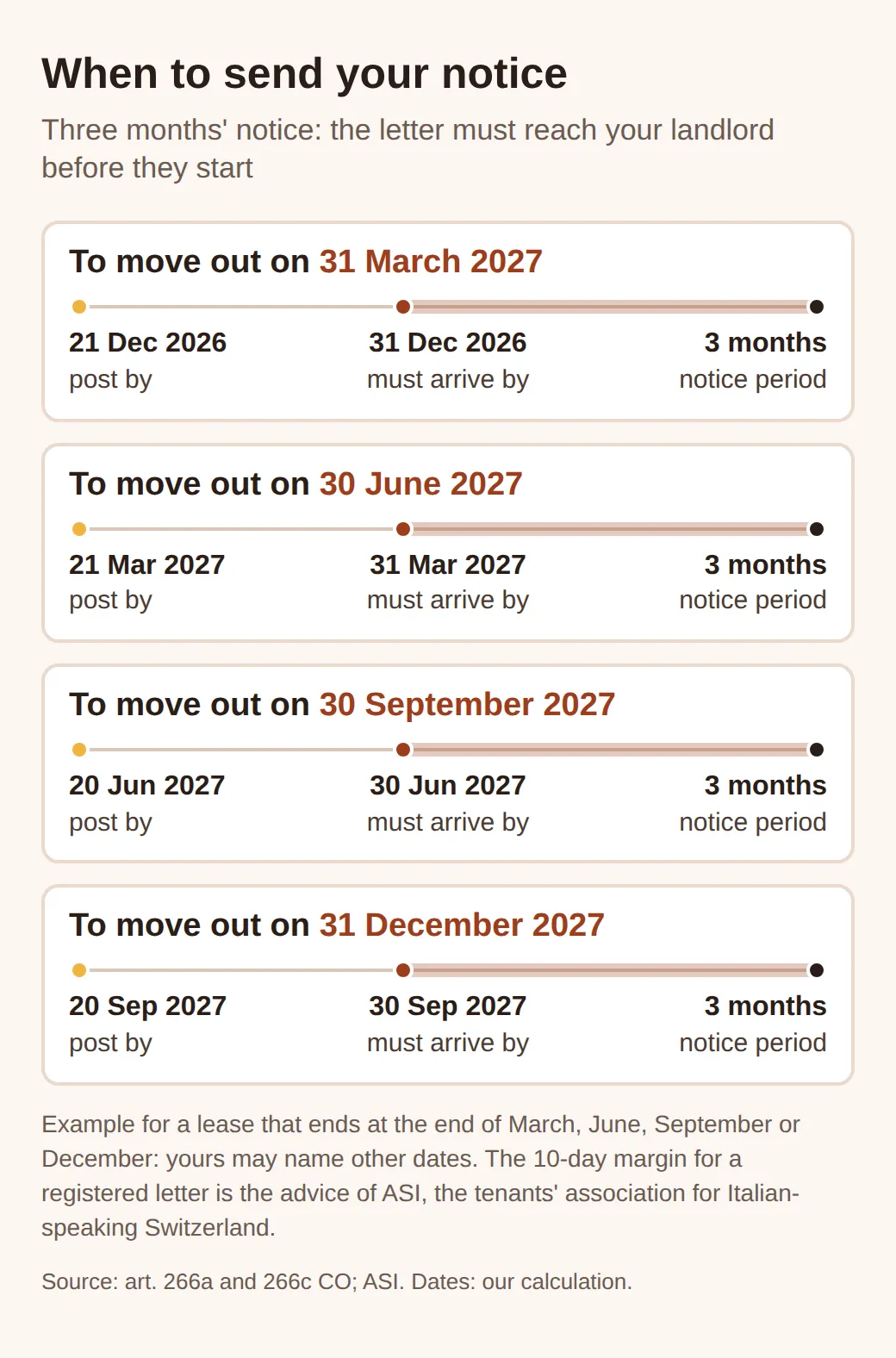
The bold dates in the middle tell you when the letter must have arrived, not when it must be posted. That difference is where most deadlines are missed.
Notice counts from the day it arrives
What matters is receipt, not the postmark. If your notice arrives after the three months have already started, it isn't lost, but it moves: it takes effect on the next termination date (art. 266a para. 2 CO). Using the dates in the chart, a letter that arrives on 2 January 2027 ends the lease not on 31 March but on 30 June. That's three more months of rent.
The Federal Supreme Court set out what "arrived" means in BGE 137 III 208 in 2011. The case was about a hotel and restaurant in the canton of Vaud. A notice dated 20 March 2008 had gone out by registered post; the postman found nobody in and left a collection slip. The tenants picked it up on 1 April and argued it had arrived too late. The cantonal court had put the date of receipt at 26 March, or the next day at the latest, and the Federal Supreme Court rejected the tenants' argument: a registered letter that could not be handed over counts as received as soon as the addressee can collect it, which means the day they find the slip in the letterbox or, as a rule, the day after.
The rule works both ways. If your landlord doesn't collect your registered letter, they can't stretch the lease by waiting. And if you are the one receiving a notice and leave the slip on the table, the days run all the same. For two acts by the landlord, a notice of rent increase and a written demand for unpaid rent, the same ruling notes that a different rule applies: the letter counts from the day it is collected or, if nobody collects it, from the seventh and last day it is held at the post office.
That's why the tenants' association for Italian-speaking Switzerland, the Associazione Svizzera Inquilini della Svizzera italiana (ASI), advises sending your notice by registered post and at least 10 days before the notice period begins. With an ordinary letter you cannot prove that it arrived, as the same ruling points out. The post office receipt is your proof. What's left is writing the right letter.
How to write your notice letter: format and signatures
In writing, signed by hand. Art. 266l CO requires notice to end the lease of a home to be given in writing, and under the Code of Obligations signatures "must be appended by hand" (art. 14 CO). A qualified electronic signature with a qualified time stamp also counts, but few private individuals have one. An email, a text message or a WhatsApp message is not enough.
Who signs? Everyone who signed the lease. If the apartment is the family home, you also need the "express consent" of your spouse or registered partner, even if their name isn't on the lease (art. 266m CO). The simplest way to prove it is their signature on the same letter, as the ASI's model letter (in Italian) provides for.
As a tenant, you don't need any official form: that is only for the landlord. A short letter will do:
By registered post
[Name and address of the landlord or managing agency]
[Place and date]
Termination of the lease
I hereby terminate the lease for the apartment at [street and number], [municipality], and for parking space no. [...], with effect from [termination date].
Please confirm receipt in writing and let me know the date and arrangements for handing back the apartment and the keys.
[Signatures of everyone named on the lease and of the spouse or registered partner]
Keep a signed copy and the registered post receipt. If the notice comes from the other side instead, the rules get much stricter.
If your landlord gives notice: Ticino's official form
The landlord must use a form approved by the canton, which tells you how to contest the notice or ask for an extension (art. 266l para. 2 CO). In Ticino the form is drawn up by the Department of Institutions, and art. 4 of the cantonal act adds three required items: the exact names of the parties and where they live, the date and the signature of the landlord or their representative, and a note that the tenant can ask in writing for the reasons for the notice. The forms are available from municipal offices. Ticino's judiciary puts it plainly:
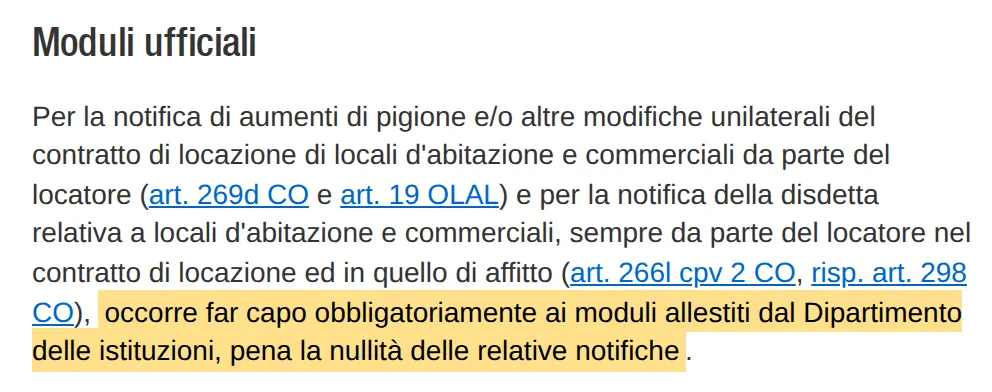
The current form, updated in April 2023, is in Italian and runs to four pages. Page 1 sets out the parties, the address of the home and the date the notice takes effect, plus four notes: you can ask for the reasons in writing, you can contest the notice and ask for an extension within a strict 30-day deadline, and the procedure is generally free of charge. Pages 2 and 3 reproduce the CO articles on protection against termination, and page 4 lists the eleven conciliation offices with the municipalities each covers. At the bottom of page 1, the form itself says it must be sent by registered post and that all four pages must be included.
When is a notice void? Art. 266o CO says so in one line: when it isn't in writing, isn't on the official form, or wasn't sent separately to the spouse. That last rule is often forgotten: if the home is the family residence, the landlord must send the notice separately to the tenant and to their spouse or registered partner (art. 266n CO). A letter on the agency's letterhead, without the form, doesn't end the lease. Our advice: even if the notice looks void to you, don't let the 30 days pass without talking to the conciliation office or the ASI. If you turn out to be right, all you've lost is a phone call.
Within 30 days: contest the notice or ask for an extension
These are two different requests, and you make both to the conciliation office within 30 days of receiving the notice (art. 273 CO). You can file them together.
Contesting means asking for the notice to be cancelled because it is contrary to good faith (art. 271 CO). Art. 271a CO lists the typical cases: notice given because you asserted a right in good faith, to force a rent increase on you, or to push you into buying the home. Notice given during conciliation or court proceedings can also be contested, as can notice given within three years of proceedings the landlord largely lost or settled. These last two protections don't apply if the notice is for unpaid rent or for the urgent need of the landlord or close relatives. Before deciding, ask for the reasons in writing: whoever gives notice must state them on request (art. 271 para. 2 CO).
Asking for an extension means staying longer, even if the notice is valid, because the end of the lease would cause "hardship" for you or your family (art. 272 CO). The office weighs how long the lease has run, the personal and financial situation of both parties, any need the landlord has for the home and the local housing market. For a home, the extension can last up to four years, granted once or twice (art. 272b CO). It is ruled out, among other cases, when the notice is for unpaid rent or for serious breaches of the duty of consideration towards neighbours (art. 272a CO). If your challenge is rejected, the authority still has to examine on its own whether the lease can be extended (art. 273 CO, para. 5). And during an extension of up to one year, you can leave with one month's notice to the end of a month (art. 272d CO).
The application is a letter to the office for the municipality where the home is, with your lease and the form you received enclosed. The ASI publishes a model (in Italian) that asks first for the notice to be cancelled and, failing that, for an extension, so both routes are covered. According to the judiciary's page, both parties must attend the hearing in person and may bring someone to assist them. If they reach an agreement, it has the force of a final judgment. On termination and extension, the office can also make a proposed judgment, which becomes final if nobody rejects it within 20 days; otherwise it issues an authorisation to proceed, and whoever wants to take it further has 30 days to go to the district court judge, the Pretore.
In Ticino, settlements are less common
In the second half of 2025, Ticino's offices closed 589 cases, according to the Federal Office for Housing report (in Italian). 78 were about an ordinary termination, 46 about an extraordinary termination and 72 about an extension.
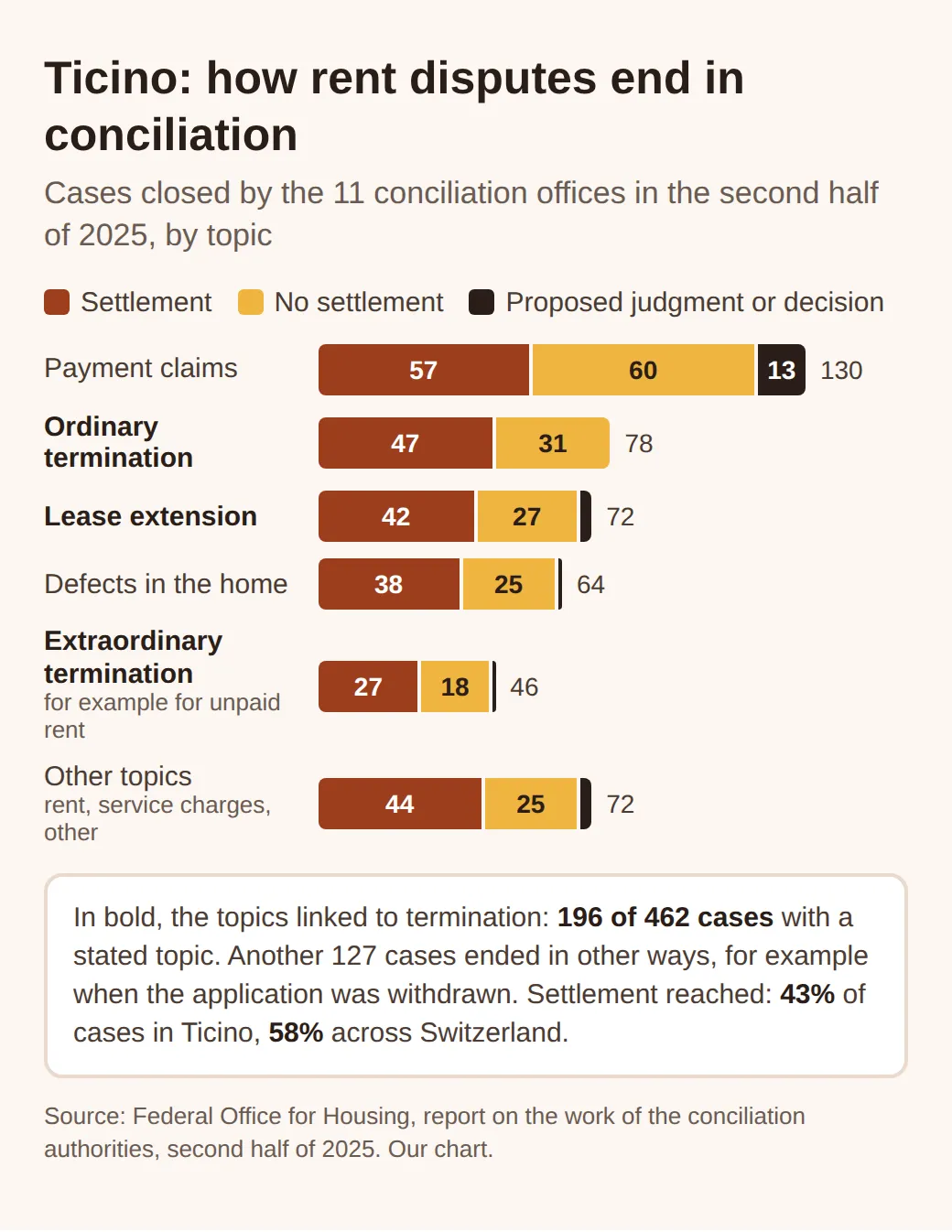
Of the 78 ordinary terminations, 47 ended in a settlement and 31 without one. Across all topics, a settlement was reached in 43.3% of cases in Ticino against 57.9% nationally, while the share of cases ending with no agreement is more than double: 31.6% against 14.2%. It isn't a one-off: in the first six months of 2025, 42.0% of Ticino's 622 cases ended in a settlement, against 59% in Switzerland, according to the previous report. The statistics don't say why. For you, the practical consequence is simple: go to the hearing with your papers in order (lease, form, the envelope or receipt showing the date, any letters) and a clear idea of what would be enough for you, for example a few more months to find a new home.
Leaving early: the replacement tenant
If you want to move out before the termination date, there is a way out: propose a new tenant. Under art. 264 CO you are released if you put forward a solvent replacement whom the landlord cannot reasonably refuse and who is willing to take over the lease on the same terms. Without such a candidate, you pay rent until the next date on which the lease could have ended. Even then, the landlord must deduct any costs they save and anything they earn by reletting the home.
When is a candidate "reasonable"? A case decided by the Federal Supreme Court shows it well. In 1986 a tenant had rented a villa in Martigny for five years, at 1,200 francs a month plus 150 francs on account for service charges. In 1988 he wanted to leave and put forward three candidates; the owner turned them all down and asked him for the rent until the villa was relet. In BGE 119 II 36 the Federal Supreme Court sided with the tenant on a decisive point: a couple with a combined net income of 3,915 francs a month could not be rejected just because rent and charges came to slightly more than a third of their income. There is no fixed threshold, the ruling says: each case is judged on its own facts, and even back then, the court noted, many young couples spent a third of their income or more on housing without being insolvent. The tenant was released from paying 7,425 francs.
The same ruling lists valid reasons for refusing: hostility between landlord and candidate, business competition, a risk of disturbing the other tenants, well-founded doubts about solvency. Vague fears, dislike or refusing a whole category of people on principle are not enough. The landlord can, however, refuse someone who wants to pay a noticeably lower rent.
In practice you need two documents, both available as ASI templates in Italian. The first is the early move-out letter, in which you announce the date you'll hand back the home, name the candidates and ask to be released from the lease. The second is the takeover declaration, which each candidate signs: it states they are willing to take over the lease on the same rent and terms from a set date. Send everything by registered post, together with the documents the landlord will need from the candidate to judge their solvency.
When the deadlines are shorter
Some terminations don't follow the three months. The best known is for unpaid rent: if you don't pay, the landlord can give you a written deadline of at least 30 days, warning that they will end the lease afterwards; if the deadline passes without payment, they can give at least 30 days' notice to the end of a month (art. 257d CO). In Ticino, 46 closed cases in the second half of 2025 concerned an extraordinary termination, a category that includes this one. An extension is ruled out against a notice for unpaid rent: the safest defence is to pay within the deadline set in the demand.
The same 30 days' notice to the end of a month applies when a tenant, despite a written warning, keeps seriously breaching the duty of care or of consideration for the neighbours (art. 257f CO). Finally, for good cause that makes carrying on with the lease unbearable, either party can give notice, with the statutory notice period, for any date; the court decides the financial consequences (art. 266g CO). It's a narrow path, and the court does the sums: if all you want is to leave early, a replacement tenant is usually more predictable.
Before you post the letter
Take out your lease and mark the next termination date you can use. Count back three months: on that day the letter must already be in your landlord's hands, and ten days earlier it must be at the post office, signed by everyone on the lease and, for a family home, by your spouse. If you're thinking of leaving early, prepare the early move-out letter at the same time and start looking for candidates straight away.
If you're the one who has received a notice, write the date you received it on the form, check that it is the complete official form and that your spouse received a separate copy, ask for the reasons in writing and contact the conciliation office for your municipality within 30 days. For advice, the ASI has regional offices for the Lugano area, Mendrisiotto, Locarno area and Bellinzona and its valleys, plus a telephone advice service, Infoalloggio, for general questions.
Once you've handed back the keys, there's still your rental deposit: we explain how to get it back in our guide to the rental deposit in Ticino. And if you're already looking for your next home, listings from across the canton are here:
Common questions
Can a new owner end my lease if the apartment is sold?
Your lease passes to the new owner as it stands. The new owner can end it early only for the next legal termination date, with the legal notice period, and only by showing an urgent need for the home for themselves or close relatives. Even then they must use the official form, and you can contest it and ask for an extension within 30 days.
Can I give notice on just my parking space?
Yes, if the parking space is rented separately from the apartment. Then two weeks' notice to the end of a month of the lease is enough. The law does not require writing for a separately rented space, but a signed letter sent by registered post is still worth it, because it gives you proof. Check your contract too, as it may ask for more.
Do I have to give notice on a fixed-term lease?
No. A lease with an agreed end date ends on that date by itself, with no notice. But if you both carry on after that date without saying anything, the law treats the lease as open-ended, and from then on the usual notice periods and termination dates apply.
How much does the rent conciliation office cost in Ticino?
The official Ticino form states that the procedure is generally free. You apply in writing to the office for the municipality where the home is, enclosing your lease and the form you received. You must attend the hearing in person, but you may bring someone you trust.
More from the blog
All posts
Ancillary costs in Ticino rentals: what you really pay
Ancillary costs on a Ticino rental: which items you pay, advance payments or flat rate, what the yearly statement must show and how to dispute a high bill.

Where is rent cheapest in Ticino? The five regions compared
Where rent is cheapest in Ticino: prices in the five regions from cantonal data, with train times and travelcard costs to Lugano.

Renting a second home in Ticino: Lex Weber and tourist tax
Renting a second home in Ticino in 2026: the three-month rule, the 56 municipalities under Lex Weber, the tourist tax and what to check before you sign.