Lugano rent prices by area and apartment size (2025 data)
The figures at a glance
In 2025 listings, an apartment in Lugano cost a median of CHF 21.3 per square metre a month, excluding ancillary costs. That ranges from CHF 17.1 per m² in Lugano North to 25 in Lugano East. A 3-room apartment cost CHF 19.6 per m²: for 75 m², that's about CHF 1,470 net and 1,700 with ancillary costs. Tenants with an existing lease pay less: in 2023, almost a fifth less per square metre.
The figures come from recent public sources, all of them in Italian. The main one is the City of Lugano's 2025 housing market report, published in October 2026, which analyses apartments advertised online from 2019 to 2025. For the rents households actually pay, we use the cantonal housing observatory and Ticino's statistics office (Ustat), both based on the Federal Statistical Office's Structural Survey. Many pages you find when you search for rent prices in Lugano quote figures from 2012 or 2023, a single apartment size and no areas. Here, every figure comes with its year and its source.
How much does it cost to rent in Lugano?
The short answer is CHF 21.3 per square metre a month, excluding ancillary costs such as heating and hot water. That's the median of 2025 listings: half the apartments on offer cost more, half cost less. With ancillary costs included, which gives the gross rent, the median rises to CHF 24.2 per m².
The data comes from property listings supplied to the City by a specialist company, Meta-Sys. So it measures supply, the price asked of people looking for a home, not what tenants who've lived there for years pay. The difference matters, and we'll come back to it.
Prices have risen a good deal in six years. In 2019 the net median was CHF 18.8 per m², in 2025 it was 21.3: up 13.4%. The peak came in 2024, at CHF 21.8; 2025 brought a drop of 2.0%, the first after three years of growth. The report links the trend to the mortgage reference interest rate, the rate Switzerland uses to calculate rent adjustments. When it stood at 1.25%, between 2020 and 2022, new listings were at their lowest (CHF 17.8 per m² net in 2021). In 2024, with the rate at 1.75%, they reached CHF 22.0.
To turn the median into a monthly rent, you just multiply it by the floor area. First, though, it's worth looking at where the apartment is, because prices change a lot from one neighbourhood to the next.
Prices by area: from Lugano North to Lugano East
The City divides its territory into five areas, and the gap between the most expensive and the cheapest is almost eight francs per square metre. On an 80 m² apartment, that's about CHF 630 a month.
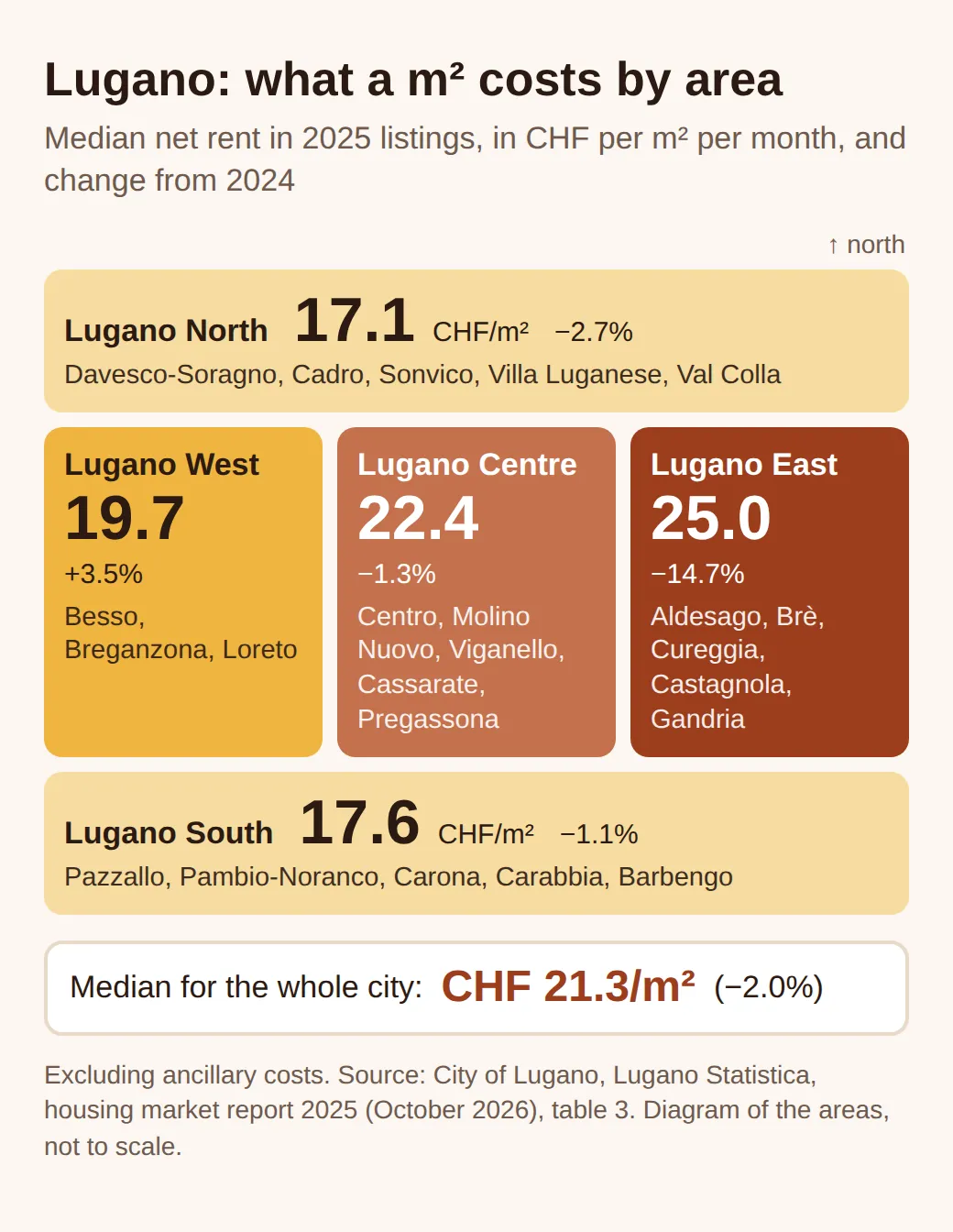
Lugano East (Aldesago, Brè, Cureggia, Castagnola and Gandria) is the most expensive area, at CHF 25.0 per m². It's also the one that moved most: in 2024 it stood at CHF 29.3, and it lost 14.7% in a year. The report doesn't explain why, and a drop that steep in a single year calls for caution before you count on lower prices. Lugano Centre (Centro, Molino Nuovo, Viganello, Cassarate and Pregassona) comes next at CHF 22.4, almost unchanged from 2024.
Three areas sit below the city median. Lugano West (Besso, Breganzona and Loreto) costs CHF 19.7 and is the only area where prices rose in 2025, by 3.5%. Lugano South (Pazzallo, Pambio-Noranco, Carona, Carabbia and Barbengo) is at CHF 17.6, Lugano North (Davesco-Soragno, Cadro, Sonvico, Villa Luganese and Val Colla) at 17.1.
Within each area the differences stay large. According to the City, the neighbourhoods with the lowest net rents are Bogno, Val Colla, Barbengo, Villa Luganese, Davesco-Soragno, Cimadera and Certara; the most expensive are Pambio-Noranco, Loreto, Cassarate, Centro, Castagnola and Gandria. Pambio-Noranco is a good example: it lies in a cheap area, yet it's among the most expensive neighbourhoods. The report shows the neighbourhoods only as a map in colour bands, from CHF 8.3 to 32.5 per m² net, without a figure for each one.
Over the long run, the centre has risen most: from 2019 to 2025, net rents there went up 15.9%, against 3.6% in Lugano North. The neighbourhood isn't just a matter of taste. Under Swiss law, a rent is generally not unfair if it falls "within the range of rents customary in the locality or district" (art. 269a of the Code of Obligations). That's another reason to know what people pay in your area. But the area alone isn't enough: the number of rooms you're after counts as well.
What you pay by number of rooms
The smaller the apartment, the more it costs per square metre. In 2025 a 1-room apartment cost a median of CHF 26.7 per m² net, one with four rooms or more 19.1. A likely reason: even a 1-room apartment has a kitchen and a bathroom, and in a small floor area they make up a bigger share of the cost.
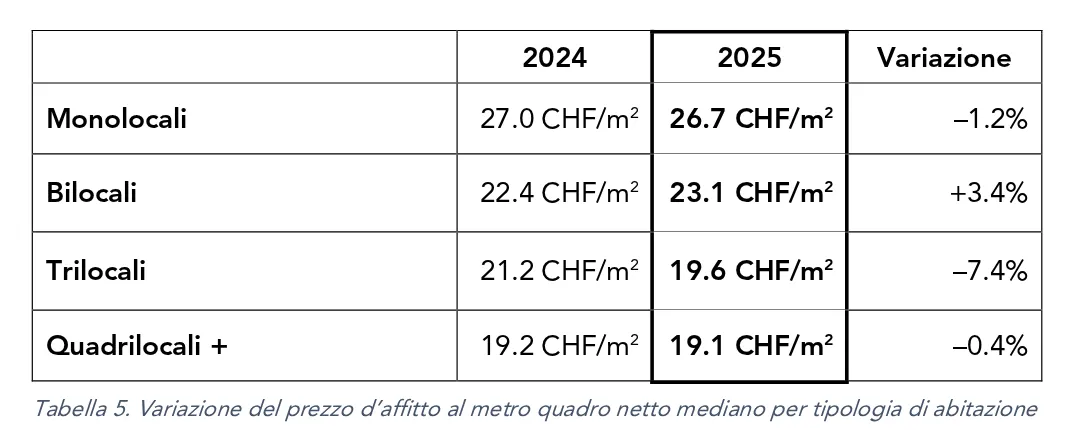
Over the last year, the sizes moved in different directions. Only 2-room apartments went up, by 3.4%. Those with 3 rooms lost 7.4%, 1-room apartments 1.2%, and those with four rooms or more held steady. Since 2019, though, they've all risen: up 15.9% for four rooms or more, 12.0% for 2 rooms, 9.9% for 1 room and 8.8% for 3 rooms.
With these medians you can estimate the rent of a listing you're looking at. Here are four examples we worked out, with sample floor areas and the median ancillary costs from the same report:
- 1 room, 35 m²: 35 × 26.7 = about CHF 935 net, about CHF 1,055 with CHF 120 of ancillary costs;
- 2 rooms, 55 m²: 55 × 23.1 = about CHF 1,270 net, about CHF 1,450 with CHF 180 of ancillary costs;
- 3 rooms, 75 m²: 75 × 19.6 = CHF 1,470 net, CHF 1,700 with CHF 230 of ancillary costs;
- 4 rooms, 95 m²: 95 × 19.1 = about CHF 1,815 net, about CHF 2,130 with CHF 315 of ancillary costs.
If a listing asks for much more than your calculation, there should be a visible reason: a lake view, a newer building, parking included. Bear in mind that Swiss listings also count half rooms (a "3.5-room" apartment), while the report talks about 1-, 2-, 3- and 4-room apartments without saying how it groups them.
Ancillary costs
Ancillary costs have risen faster than rents. In 2025 the median in new listings was CHF 120 a month for a 1-room apartment, 180 for 2 rooms, 230 for 3 rooms and 315 for four rooms or more. Compared with 2019, that's up 20% for 1 and 2 rooms, 15% for 3 rooms and 16.7% for the largest. Per square metre they fall as the apartment grows, from CHF 3.2 for 1 room to 2.5 for four rooms.
So when you compare two listings, look at the gross rent. A low net rent with high advance payments for ancillary costs can cost as much as a higher net rent with modest ancillary costs. And so far we've only talked about listings: people who signed their lease years ago pay a different figure.
Listings and existing leases: two different prices
If you're looking for a home, you pay more than people who already live in theirs. That's what the figures from the cantonal housing observatory (Osservatorio cantonale sull'alloggio) show; its reports are written for the canton by SUPSI, the University of Applied Sciences and Arts of Southern Switzerland. The observatory compares listings (data from the firm Wüest & Partner) with the rents of existing leases (from the federal Structural Survey).
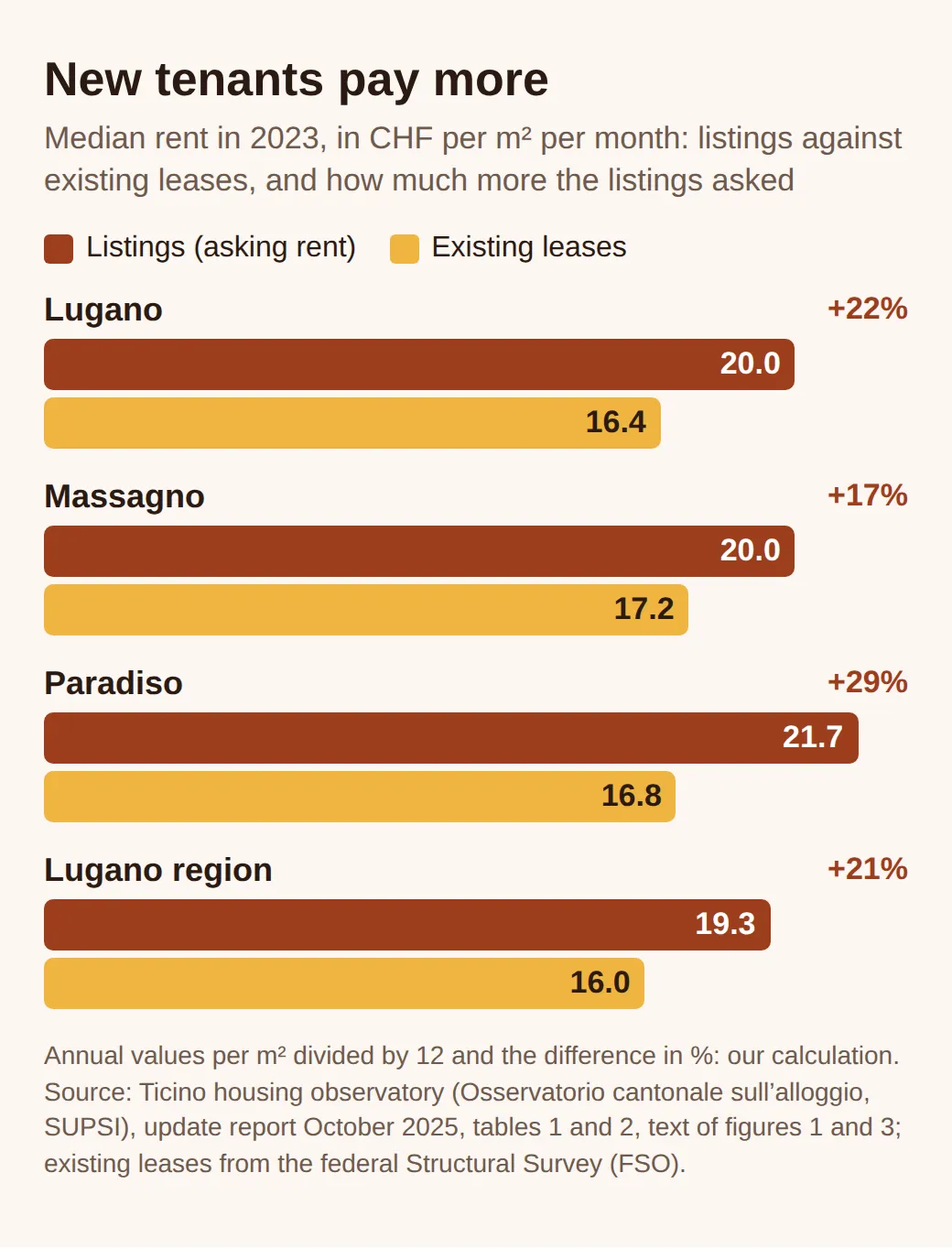
In 2023, the latest year with both figures, listings in Lugano asked CHF 240 per m² a year, or 20.0 a month. Existing leases cost CHF 197 a year, 16.4 a month: 18% less. Put the other way round, people looking for a home faced prices 22% higher, the figure in the chart. In Paradiso the gap was even wider, in Massagno a little narrower. The observatory's figures don't match the City's because they come from a different set of listings, and the report doesn't say whether they include ancillary costs. But they tell the same story.
The reason lies in Swiss tenancy law. During a lease, the rent can change only for specific reasons, such as a change in the reference interest rate or in costs, and only on the official form. When a tenant moves out, the landlord can set the rent at market level again. Someone who has lived in the same apartment for ten years may pay much less than the neighbour who's just moved in.
For rents actually paid, Ustat publishes averages by number of rooms, but only for the canton as a whole, not for Lugano. In 2024 a rented home in Ticino cost an average of CHF 1,245 net a month, against 1,485 across Switzerland (table T_050401_05C). By number of rooms:
| Rooms | Ticino, average net rent 2024 |
|---|---|
| 1 | CHF 797 |
| 2 | CHF 1,043 |
| 3 | CHF 1,249 |
| 4 | CHF 1,472 |
| 5 | CHF 1,830 |
The age of the building matters too. A 3-room home built between 2021 and 2024 cost an average of CHF 1,695 net, one built in the 1960s 1,152. Our example of a 75 m² 3-room apartment in Lugano, CHF 1,470 net at 2025 listing prices, is therefore above the cantonal average but below that of a new 3-room apartment.
These averages don't tell you what you'll pay. They tell you how much room there is to negotiate and which figure is out of line with the market. To gauge it, it also helps to look at how quickly apartments are let.
How long an apartment stays on the market in Lugano
Not long. In 2025 a rental listing in Lugano stayed online for 48 days on average, according to the City's report. In 2021, when rents were at their lowest, it was over 80 days. Apartments are let faster than a few years ago: for the City, that's the sign of a more dynamic market, where a home stays available for less time.
Empty homes are getting scarcer too. On 1 June 2025, Lugano's vacancy rate was 2.08% (Ustat, topic 09). By 1 June 2026 it had fallen to 1.78% across Ticino, the lowest since 2017, and Lugano is still just above the cantonal average (Ustat statistical bulletin 2026-31). These rates also count second homes, which are very common in Ticino, and Ustat warns that they tend to come out lower for that reason.
In practice: if a listing looks fair against the figures above, don't wait too long. If it looks expensive, you have two tools before you sign.
Before you sign: ask for the previous rent
You have the right to know what the previous tenant paid. Art. 256a para. 2 of the Code of Obligations says so: "the new tenant or lessee has the right to be informed of the amount of rent paid under the previous lease." The Code lets cantons with a housing shortage require an official form that states the previous rent as soon as the lease is signed (art. 270 para. 2 CO); in Ticino, the cantonal tenancy act leaves that choice to the Council of State, the cantonal government (art. 4). If the lease you're offered doesn't come with that form, you have to ask for it yourself, preferably in writing. Your landlord will most likely expect Italian, and a short letter like this one does the job:
Gentile signora, gentile signore, in vista della firma del contratto per l'appartamento di via [...], n. [...], piano [...], Le chiedo, come previsto dall'art. 256a cpv. 2 CO, di comunicarmi l'importo della pigione netta e degli acconti per le spese accessorie pagati dal precedente inquilino. Grazie e cordiali saluti.
In English, it reads: ahead of signing the lease for the apartment at [street, number, floor], I ask you, as provided by art. 256a para. 2 CO, to tell me the net rent and the advance payments for ancillary costs paid by the previous tenant.
If the new rent is much higher than the old one, you have a second tool: you can challenge the initial rent as unfair before the rent conciliation office (Ufficio di conciliazione in materia di locazione) within 30 days of taking possession of the apartment (art. 270 para. 1 CO). The law allows this if the landlord has raised the rent "significantly" compared with the previous one, or if you felt compelled to sign because of personal or family hardship or the state of the local housing market. The deadline is short and the procedure has its own rules, so get advice from a tenants' association before you act.
When you sign, you'll almost certainly be asked for a rent deposit as well, of up to three months' rent. We explain how it works in Ticino in our guide to the rent deposit.
How to use these figures in your search
Start from the area and the number of rooms, not from the median for the whole city. Multiply the listing's floor area by the median for its size, add the median ancillary costs and compare the result with the gross rent asked. If the numbers add up, the listing is in line with the 2025 market. If they don't, ask for the previous rent before you sign.
Keep in mind that the City's figures refer to 2025. The reference interest rate is 1.25%, and the Federal Office for Housing (page in Italian) will publish it again on 1 December 2026: if it changes, rents under existing leases can be adjusted, up or down.
You'll find the apartments available in the city on our page of apartments for rent in Lugano: pick a listing and try the calculation straight away.
If a room is all you need, Lugano has those too.
Common questions
How much do I need to earn to rent an apartment in Lugano?
In its report, the City of Lugano treats housing as affordable when it takes no more than 30% of gross income. A 3-room apartment at CHF 1,700 a month including ancillary costs therefore calls for a gross income of about CHF 5,670 a month. In 2025, only 31% of listings were within reach of households with an income at the relative poverty line.
Can my landlord raise the rent if the reference interest rate changes?
The mortgage reference interest rate has been 1.25% since 2 September 2025, and the Federal Office for Housing is due to publish it next on 1 December 2026. If the rate goes up, your landlord can ask for an increase, but must give reasons and use the official form approved by the canton, or the increase is void. If the rate goes down, you can ask for a reduction.
Do these prices also apply to Paradiso and Massagno?
No. They are separate municipalities, and the City of Lugano's statistics don't cover them. For 2024 listings, the cantonal housing observatory gives CHF 278 per m² a year in Paradiso and 243 in Massagno, the same figure as in Lugano. That's about CHF 23.2 and 20.3 per m² a month.
Do rents per square metre in Lugano include ancillary costs?
It depends on which figure you're reading. Net rent leaves them out, gross rent includes them. In Lugano in 2025, the median in listings was CHF 21.3 per m² net and 24.2 gross, so always check which of the two a listing shows.
More from the blog
All posts
Mould in a rented apartment: who pays? The rules in Ticino
Mould in a rented apartment in Switzerland: when the landlord pays and when you do, how much rent reduction Ticino courts grant and how to claim it.
Rent deposit in Ticino 2026: limit, insurance and refund
Rent deposit in Ticino: three months' rent at most, a blocked account in your name within 10 days, what deposit insurance costs and the refund after a year.
Ancillary costs in Ticino rentals: what you really pay
Ancillary costs on a Ticino rental: which items you pay, advance payments or flat rate, what the yearly statement must show and how to dispute a high bill.