Pets in a Swiss rental apartment: what landlords can ban
The short answer
In Switzerland, your lease decides. Fish, hamsters, guinea pigs and caged birds are almost always allowed, even when the lease bans pets. For dogs and cats you need the landlord's consent if the lease asks for it, and under current case law the landlord can refuse without giving a reason. Once given, though, a yes can't be withdrawn on a whim.
Many English-language pages on this topic describe the rules in the UK or the US. They don't apply here. Swiss tenancy law doesn't say a word about pets, and the answers come from three places: the lease, the tenant's duty of care and a handful of court rulings. We read them, from a Yorkshire terrier in Lausanne to a husky in a Vaud housing cooperative, to see where the line is and what crossing it costs.
What Swiss law says
Nothing specific. The Code of Obligations only asks you to use the apartment with due care and to "show due consideration for others who share the building and for neighbours" (art. 257f CO). The rest is up to the lease.
The High Court of the Canton of Zurich summed it up well in a ruling of 16 June 2015 (in German): since 2003, animals are no longer things under Swiss law, but tenancy law was never adapted. So tenants have no general right to keep pets, except for the small animals that are part of normal use of a home. For all others, the lease can do one of four things: ban them, require the landlord's prior consent, expressly allow them or say nothing at all.
And if the lease says nothing? According to the tenants' association of German-speaking Switzerland (Mieterinnen- und Mieterverband, MV), pets are then usually allowed, except those that can be very disruptive or dangerous, such as parrots, venomous snakes or a large number of animals. In Ticino, the ASI, the tenants' association of Italian-speaking Switzerland (Associazione Svizzera Inquilini), urges caution. In 2022 a family in Stabio, living in a small house with a garden, got a little dog, believing the lease didn't forbid it, and told the landlord. A few days later, notice of termination arrived. In fact, tio.ch reports (in Italian), the lease had an added clause: no animals without written permission. The ASI's general secretary commented that even a lease silent on the subject is no mitigating factor, and that it always pays to raise it first.
There's also a point specific to Ticino. According to the ASI, the general conditions of CATEF, the Ticino property owners' association (Camera ticinese dell'economia fondiaria), which are the most widely used in the canton's leases, ban keeping pets (tio.ch, 2023, in Italian). The text isn't freely published: CATEF sells its lease forms and general conditions. If your lease refers to general conditions, read them before you sign, because that's usually where the pet clause sits.
Which small animals are allowed anyway
Those that live in a cage, a terrarium or an aquarium, in the usual numbers and without causing trouble. The tenants' association lists hamsters, guinea pigs, budgies and aquarium fish, and says they are allowed whatever the lease says, as long as there aren't too many and nobody complains. The lease in the Zurich case spelled it out: small animals such as hamsters, canaries and ornamental fish could be kept without consent, within the usual limits.
What "the usual numbers" means depends on the species. Under the federal Animal Welfare Ordinance (in German; there is no English version), animals of social species must have adequate contact with their own kind, and the Federal Food Safety and Veterinary Office (FSVO, page in German) says guinea pigs must live in groups of at least two. So two guinea pigs are the minimum, not too many. The golden hamster, on the other hand, is solitary and should be kept alone.
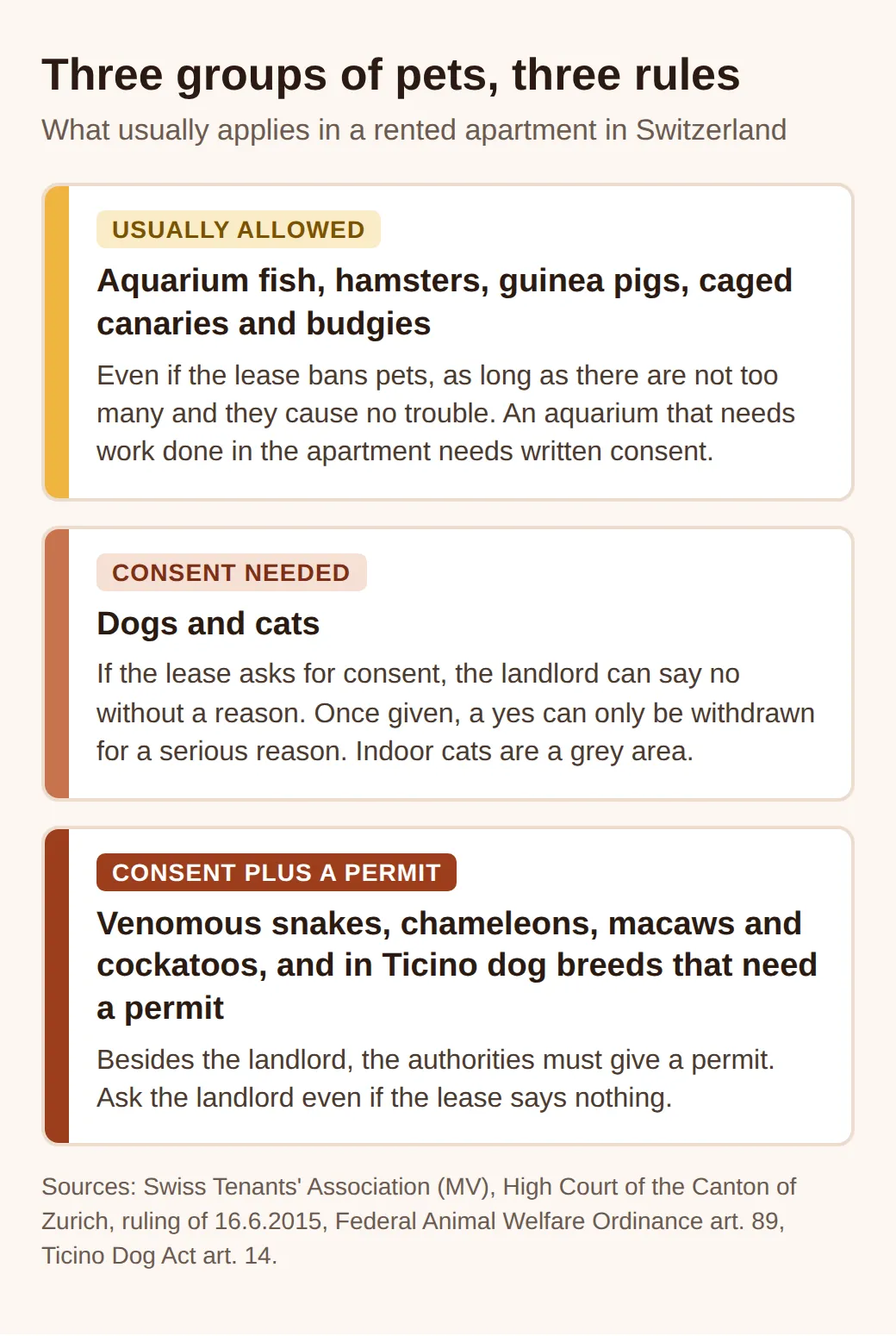
Two cases are less clear-cut. The first is the large aquarium: if it needs work done in the apartment, you need the landlord's written consent, and the tenants' association recommends liability insurance that covers water damage. The second is the indoor cat. According to the tenants' association, the trend today is to treat it as a small animal, but the question isn't settled. With a cat, in short, you're better off doing what you'd do with a dog and asking.
Can a landlord refuse a dog or a cat?
Yes, if the lease makes pets subject to the landlord's consent, under current case law. The clearest case is the one from Zurich. A tenant had lived since 2005 in a two-room ground-floor apartment owned by a housing cooperative, for a net rent of 530 francs. The general conditions allowed small animals, while larger pets such as cats, rabbits, dogs, parrots and reptiles needed written consent. In 2013 she asked to keep her partner's dog, as he was going abroad for a long time. She attached the written consent of most of the other tenants and a model agreement on keeping dogs. The cooperative's board said no unanimously: it wanted to treat everyone the same.
The tenant sued and lost twice. The High Court held that under that clause, consent was at the landlord's free discretion (freies Ermessen), limited only by the ban on abuse of rights. The court acknowledged that most legal writers require a serious reason for a refusal, but read the clause as it was written: it set no conditions, so the landlord could decide freely. For the appeal alone, she had to pay 1,450 francs in court costs and 1,371.60 francs in compensation to the cooperative.
The practical lesson is that the right moment to ask is before you sign, while the landlord is still choosing a tenant and can write an exception into the lease. After that, the landlord holds all the cards. A short, concrete request works better than a long one. Landlords and agencies in Ticino work in Italian, so here is a sample in Italian. It says: I am asking for your written consent to keep my dog in the apartment; the dog is vaccinated and covered by liability insurance that includes damage to the home; I suggest stating in the lease the species and number of animals allowed, and I attach the insurance certificate.
Gentile signora, egregio signore, Le chiedo il consenso scritto per tenere nell'appartamento [address] il mio cane [breed, age, weight], vaccinato e assicurato con una responsabilità civile che copre i danni all'alloggio. Le propongo di indicare nel contratto la specie e il numero degli animali ammessi. Allego il certificato dell'assicurazione.
If the landlord agrees, have the species and number of animals written into the lease. A verbal promise is hard to prove, as the ASI's general secretary already pointed out in 2023.
Consent can't be withdrawn on a whim
Once given, consent can only be withdrawn for good cause. The same Zurich ruling says so: withdrawal can't be arbitrary, because the tenant relied on the permission. The Tier im Recht foundation (in German), which works on animals and the law, adds that a mere change of mood on the landlord's part isn't enough. Valid reasons, on the other hand, are complaints from neighbours about disturbance that really goes beyond what is reasonable to put up with, or an animal not kept in a way that suits its species.
Trickier is the pet that's tolerated without a written yes. The tenants' association treats an animal the landlord knew about as tacitly allowed, and gives the example of a dog kept for three years. The Tier im Recht foundation is more cautious: even years of silent tolerance don't necessarily count as consent. Both readings exist side by side, and a judge could follow either. That's why the advice is the same as before: even if the landlord has known about your cat for years, an email confirming it today can spare you a court case tomorrow.
A pet without permission: warning, notice and what the courts decide
If you keep a banned or unapproved pet, you risk losing the apartment, but the landlord's fastest route has strict rules. Extraordinary termination takes three things (art. 257f para. 3 CO): a written warning, you carrying on despite it, and a situation the landlord or the other people in the building can no longer reasonably be expected to bear. The notice period is at least 30 days, ending on the last day of a month. The landlord can also choose ordinary termination, with the normal notice periods.
Three Federal Supreme Court rulings show how this plays out in practice. A foundation in Lausanne had rented out a subsidised four-room apartment since 1995 with a clear clause: no dogs in the building. In March 1999 the management discovered the tenants' Yorkshire terrier and gave them until 9 April to part with it. They didn't, and on 15 April notice arrived for 1 June. The Vaud rent tribunal found that the conditions for extraordinary termination weren't met, treated it as ordinary notice and granted a two-year extension. The Federal Supreme Court (ruling in French) upheld the extension on 6 February 2001.
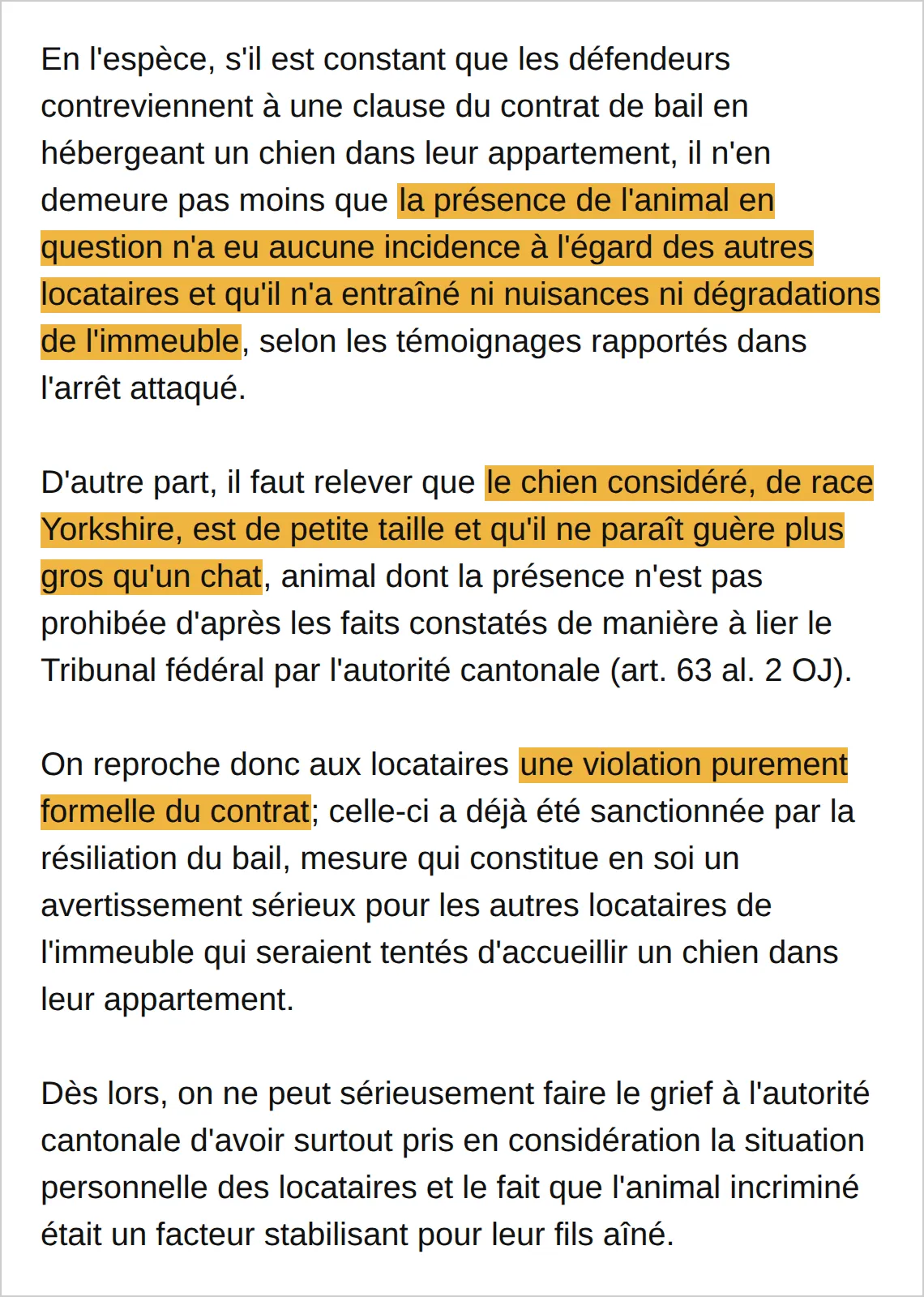
The court's words are worth reading. The dog had caused "ni nuisances ni dégradations", neither disturbance nor damage, it was "guère plus gros qu'un chat", hardly bigger than a cat, and the tenants were blamed for a "violation purement formelle du contrat", a purely formal breach of the lease. For the couple's elder son, the dog was also a stabilising factor. What counts, though, is the outcome: the notice stayed valid. The tenants got time, not the right to stay.
The second case ends the other way round. A tenant of a Vaud housing cooperative, in a two-room apartment renting for 685 francs, had a lease that banned dogs. In 2007 the cooperative changed its statutes, and he chose to become an ordinary tenant under the Vaud rental rules (Règles et usages locatifs), which allow dogs as long as they don't disturb anyone or make a mess. In 2015 he got a husky and was given notice. The neighbours confirmed twice that they weren't bothered. The Federal Supreme Court (in French), on 28 June 2018, let the Vaud decision stand: the notice was ineffective. Those rental rules only apply in the canton of Vaud, but the case shows how much it matters to read everything the lease refers to.
Finally, there's an older ruling of 21 February 1994, known through the Zurich decision. A tenant had asked permission for a dog, received a reasoned no, withdrawn his challenge and then got the dog anyway. He didn't give it away within the ten days the landlord demanded, and was given notice. For the Federal Supreme Court the notice wasn't abusive, whatever the reason for the refusal.
If you receive notice, the deadline matters most. You have 30 days from receipt to challenge it before the conciliation authority or to ask for an extension of the lease (art. 273 CO). The landlord must use the canton's official form, or the notice is void. And watch out: if the notice is a valid extraordinary termination for a serious breach of your duty of care, no extension is granted (art. 272a CO). You'll find the deadlines and the steps of the procedure in Ticino in our guide to terminating a lease.
Damage: what you pay and what you don't
You pay for damage beyond normal wear and tear, but only for the value the damaged item still had. The law asks you to return the apartment "in a condition that accords with its contractually designated use" (art. 267 CO). If the landlord allowed a dog, normal wear and tear is part of that use. A deeply scratched door or a fitted carpet soiled by the animal go beyond it: for damage like that, the Tier im Recht foundation notes, the tenant is liable.
Even then, you don't pay for new. Tenants and landlords, that is the tenants' association and the homeowners' association HEV, have agreed a joint table of how long the parts of a home last. The tenants' association (in German) explains the calculation with a mid-range fitted carpet that lasts 10 years: if it's 6 years old, 4 remain, and you pay 40% of a new carpet. If its lifespan has already run out, you pay nothing. A RaiffeisenCasa and Beobachter fact sheet (in Italian) gives other typical lifespans: 10 years for parquet sealing, 40 for solid parquet, 8 for emulsion paint on the walls.
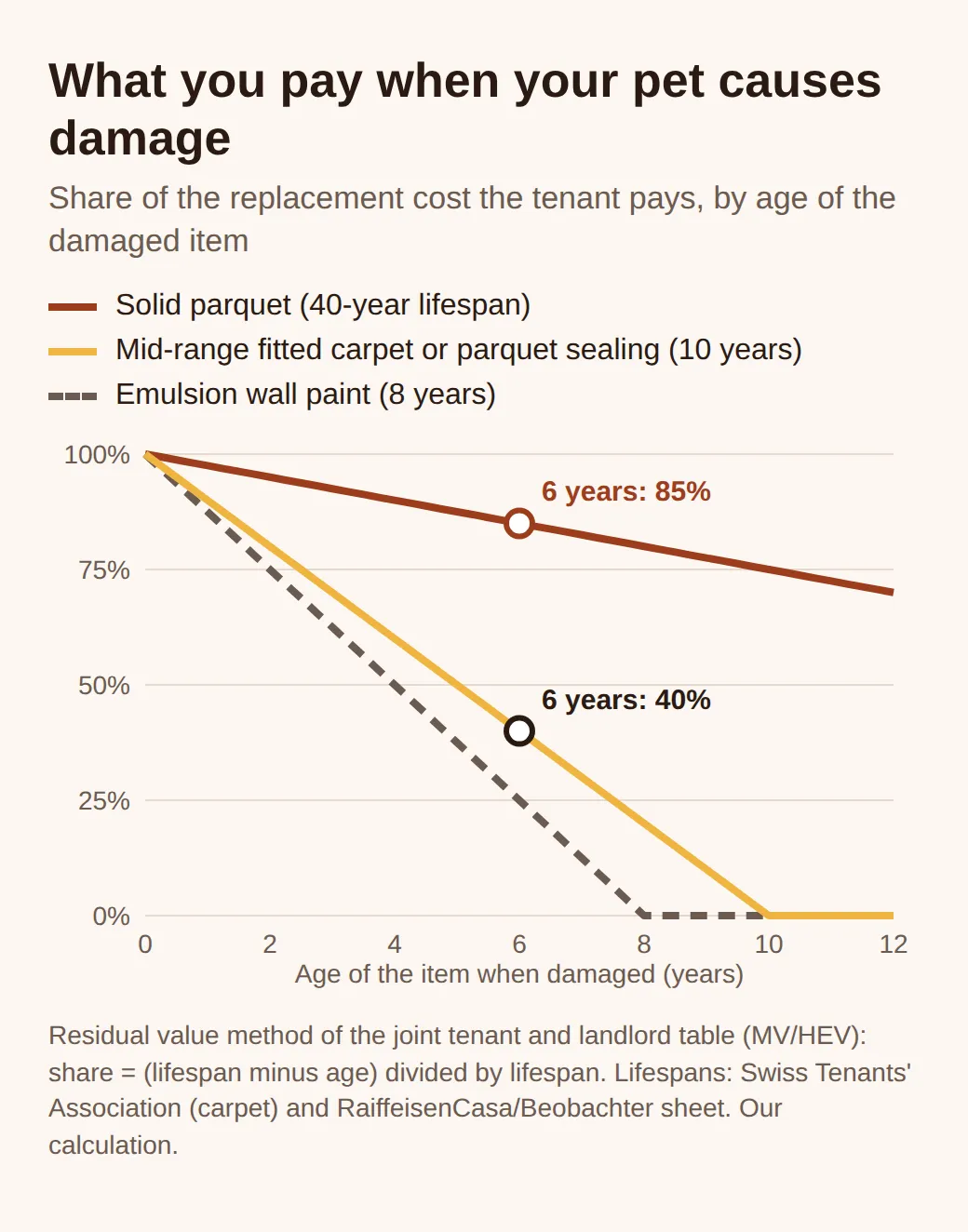
The chart shows why the same scratch can cost a lot or next to nothing. Deep scratches in 6-year-old solid parquet will mostly be on you. Walls painted 8 years ago, by contrast, the landlord would have repainted anyway. The landlords' side came from CATEF's cantonal secretary, speaking to tio.ch: she had seen ruined gardens and scratched doors, and for a 20-year-old door the tenant's liability insurance pays only a fifth of the cost of a new one. The owner is left with the difference, which is one reason many landlords are cautious.
Two rules protect you. First, when you hand the apartment back, the landlord must inspect it and tell you straight away about any defects you're liable for, or you're off the hook, except for defects that a normal inspection couldn't reveal (art. 267a CO). Second, a clause that commits you in advance to pay a sum at the end of the lease that does more than cover possible damage is void (art. 267 para. 2 CO). A fixed "pet fee" due on moving out whatever the state of the apartment falls under this rule. In practice, before you pay, ask for the quote or the invoice for the repair and check that the bill takes the item's age into account.
Then there's insurance, the point many people discover too late. Personal liability insurance doesn't necessarily cover damage your pet does to a rented apartment. AXA, for example, offers it as an add-on called "Pet damage to rental apartments", with the example of cats scratching doors and the note that it covers wear and tear too. Check your policy before you sign the lease, not when you hand back the keys. For dogs in Ticino, liability insurance is compulsory anyway (Dog Act, art. 5, in Italian).
The deposit: no pet surcharge above three months' rent
Your landlord can't ask for a higher deposit because of your dog if that takes it over the cap. For a home, the security can't exceed three months' rent in total (art. 257e CO). A separate "pet deposit" is added to the normal deposit and has to stay within the same limit.
At the end of the lease, the landlord can't simply help themselves either. The account is blocked, and the bank only pays out with both parties' signatures, or on the basis of a final payment order or a final court decision. If you dispute a bill for pet damage, don't sign a release for the full amount. How the account, the refund and the one-year rule work is explained in our guide to the rental deposit in Ticino.
Before you sign with a pet
Signing is when everything is decided. Tell the landlord up front what pet you have, ask to read the general conditions and the house rules, and have the species and number of animals allowed written into the lease. Check that your liability insurance covers damage your pet does to the home. On move-in day, photograph the doors, floors and walls, and have every existing defect noted in the handover report: at the end of the lease, that's your evidence.
If you're looking for a home with a pet, below you'll find apartments and houses for rent across Ticino. Every listing is a different lease: ask about your pet with each landlord, every time.
Common questions
Can house rules ban pets in a Swiss apartment building?
Yes, if your lease refers to them: according to the tenants' association, the house rules are then usually binding, and they often regulate pets in detail. Unlike in Italy, Swiss law has no rule that stops a building from banning pets. So before you sign, ask for the house rules as well, not just the lease.
How much does it cost to keep a dog in Ticino?
The cantonal Dog Act sets an annual dog tax, fixed by your municipality at between 75 and 125 francs. Dog owners must also have liability insurance, extended to anyone who looks after the dog now and then. On top of that comes the landlord's written consent, if your lease asks for it.
Can I keep a snake or a chameleon in a rented apartment in Switzerland?
For some species, the landlord's yes is not enough. The federal Animal Welfare Ordinance requires a permit to keep, among others, venomous snakes, all chameleons, macaws and cockatoos at home. According to the tenants' association, animals like these always need the landlord's agreement, even if the lease says nothing.
If I rehome my pet after a written warning, can my landlord still end the lease?
Extraordinary termination requires you to keep breaching the lease despite a written warning. If you meet the deadline in the warning, that route is usually closed. The landlord can still give ordinary notice, which you can challenge within 30 days if you think it breaches good faith.
More from the blog
All posts
Renting a second home in Ticino: Lex Weber and tourist tax
Renting a second home in Ticino in 2026: the three-month rule, the 56 municipalities under Lex Weber, the tourist tax and what to check before you sign.

Ancillary costs in Ticino rentals: what you really pay
Ancillary costs on a Ticino rental: which items you pay, advance payments or flat rate, what the yearly statement must show and how to dispute a high bill.
Mould in a rented apartment: who pays? The rules in Ticino
Mould in a rented apartment in Switzerland: when the landlord pays and when you do, how much rent reduction Ticino courts grant and how to claim it.