Documents you need to rent an apartment in Ticino (2026)

Before the viewing
To apply for an apartment in Ticino you usually need four things: the agency's application form, an extract from the debt enforcement register (18 francs online), your income and your type of residence permit. Payslips and copies of your ID, on the other hand, can only be demanded from the applicant the landlord has chosen. And some questions they may not ask anyone.
The rule comes from the Federal Data Protection and Information Commissioner (FDPIC), who wrote a factsheet specifically on application forms. Here you'll find the list for Ticino, how to order the extract, what to do if it shows a debt and which questions you can leave blank.
The application dossier: four documents, two stages
Your application dossier comes together in two stages. First every applicant fills in the form; then the landlord picks one or more people and asks only them for proof. That is what the FDPIC factsheet on application forms for rental apartments (in Italian; also published in German and French) says, in its July 2025 update: asking every applicant for supporting documents for every answer right at the start is disproportionate, because the information on the form is enough to make a choice.
In practice, for the first stage you need:
- the application form, filled in and signed, one for each person who will sign the lease;
- a copy of your debt enforcement register extract;
- your annual income, given in bands on the form;
- your type of residence permit and its expiry date, if you're not a Swiss citizen.
In the second stage, once the lease is about to be signed, the landlord may ask for a copy of your ID card or permit, your salary certificate or a few payslips, the original of the extract and, to draw up the lease, your bank details and proof of household contents insurance. If you named references, this is also when the landlord may contact them.
Keeping your documents ready in one tidy PDF is still a good idea: once the choice is made, things can move fast. But the starting point is the form, and that's where the trickiest part lies.
What a landlord can ask on the application form
A landlord may ask what they need to choose a tenant who pays and looks after the place, and nothing more. The principle is proportionality under Article 6 of the Federal Act on Data Protection (FADP): only data that is suitable and necessary for the purpose may be collected.
So name, date of birth, address and phone number are fine for anyone who signs the lease or acts as guarantor. Occupation and employer are fine too, but only for those who sign: the job of your adult son who will live with you doesn't change the landlord's risk. On income, the landlord has to settle for a rough figure in bands, and according to the FDPIC the top band should not go above 150,000 francs a year, except for very high rents.
Questions about pending debt enforcement and about certificates of loss are also allowed. A certificate of loss is the document a creditor keeps when a seizure of your assets doesn't cover the debt. The limit is five years, the same period during which third parties can look at the register.
About your current home, the landlord may ask whether your landlord has ended your lease and why. They may not ask how long you've lived there or how much you pay: the Federal Data Protection Commission decided this in a ruling of 28 August 2003, quoted in the factsheet. They may ask how many people will live in the apartment, whether it will be a family home and whether you have pets. On pets, the factsheet notes that the question hardly matters for a hamster or a goldfish; for the rules on dogs and cats, see our article on pets in a rented apartment.
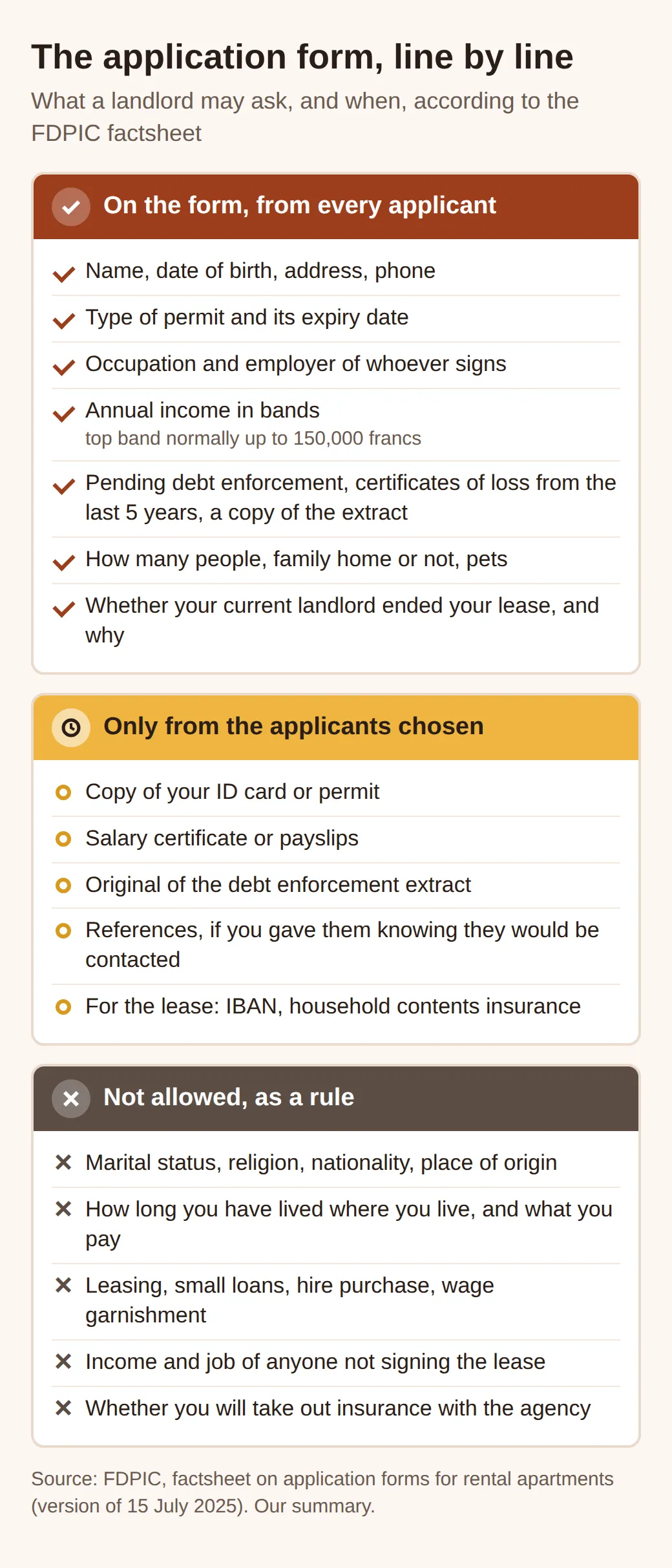
References deserve a line of their own. A landlord may only contact your employer or your current landlord if the form made it clear that by naming them you were agreeing to it. If the field is mandatory and the form doesn't say so, that consent doesn't count. And even with consent, they may only call if you're on the shortlist, and only to confirm what you wrote.
Questions a landlord can't ask you
Some questions are excluded as a rule, even though they appear on many forms. Here they are, all taken from the factsheet:
- marital status. It says nothing about whether you'll be a good tenant, and answers like "divorced" or "widowed" can touch on your private life. The landlord may, however, ask in a separate question whether the apartment will be a family home, because tenancy law has special rules for one;
- religion, which counts as sensitive personal data;
- nationality and place of origin, which can be used to discriminate. Your residence permit, by contrast, is a fair question, because how long it runs can affect how long the lease runs. And your answer about the permit already shows whether you're Swiss or not;
- leasing, small loans, hire purchase, retention of title on furniture and wage garnishment. They only give a partial picture of your finances, and the debt enforcement extract is enough;
- how long you've rented your current home and what you pay for it, as above;
- whether you'll take out insurance with the agency. A side deal tied to the lease and made a condition of it is void under Article 254 of the Code of Obligations (in Italian).
The factsheet is frank about the problem: people looking for a home aren't really free to refuse a question, because an incomplete form ends up at the bottom of the pile, and some landlords say they don't consider it at all. That's why the consent you give by filling in the form is a weak justification. Our practical advice: leave the boxes on marital status and nationality empty, and fill in the one on your permit carefully, since it gives the landlord the legitimate information they're after. As for small loans, the debt enforcement extract already answers the real question.
Once the lease is signed with the chosen tenant, the landlord must destroy the other applicants' forms with all attachments, including the copies of the extract, unless you agreed to stay on a waiting list. And your data may not be passed to other agencies without your consent. The document that most often ends up in those piles is the extract itself, so let's look at how to get one.
How to order a debt enforcement extract in Ticino
In Ticino, the cantonal debt enforcement extract, also called a certificate of solvency (certificato di solvibilità), can only be ordered online. The online services page of the cantonal debt enforcement and bankruptcy section (Sezione di esecuzione e fallimento, in Italian) says so. The form for private individuals (in Italian) asks for the district you live in, your personal details, an email address and one attachment: a copy of your ID card or passport if you're Swiss, or a copy of both sides of your permit if you're not.
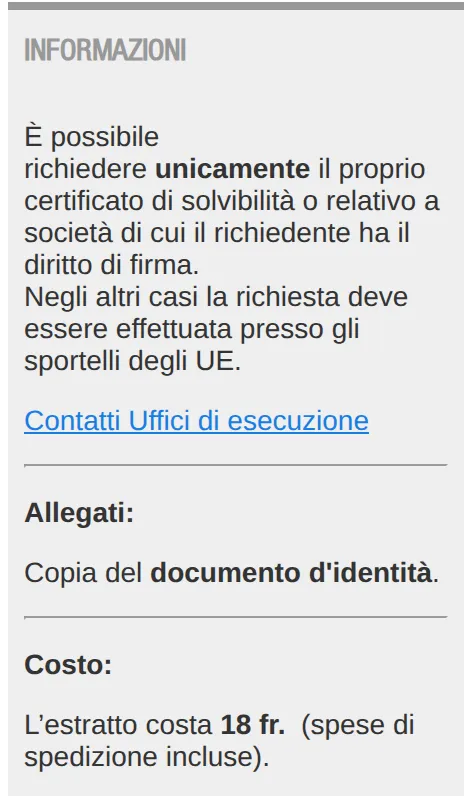
The extract costs 18 francs including postage, and you pay with TWINT, a credit card or through PostFinance. You can get it by email, the fastest way according to the canton, or by post. If you choose email, the office asks you to check your spam folder before chasing it up. You can also go through Swiss Post, which passes the order on to the competent office, but that costs 26.90 francs online and 35 francs at a branch.
Online, you can only order your own extract; for every other case the form sends you to the counters of the debt enforcement offices. A landlord who wanted someone else's extract would have to explain why and attach proof of their interest, such as a preliminary rental agreement, as the canton's page on the extract (in Italian) explains. The legal basis is Article 8a of the Debt Enforcement and Bankruptcy Act (DEBA), which opens the registers to anyone who can show a credible interest. Usually, though, it's the landlord who asks you for the extract.
One detail matters if you've moved. An extract only shows the proceedings registered in the debt enforcement district where you order it, and the ch.ch portal advises ordering one in each district where you've lived in the past five years. So the Ticino extract won't show debt enforcement from Zurich or Geneva: if you moved from there less than five years ago, a careful landlord may ask you for that extract too. Which leaves the question of how old the extract you hand over can be.
How recent does the extract need to be?
DEBA gives the extract no expiry date: whoever asks for it decides. In Ticino, the City of Lugano offers a concrete benchmark. For the city's moderate-rent apartments (alloggi a pigione moderata, in Italian), managed for the city by the company GiPi, the questionnaire has to come with an extract no more than three months old.
Three months is a good yardstick for the private market too. Order the extract when you really start looking, not before, and order a new one once the first is more than three months old. At 18 francs with delivery by email, a second extract costs little compared with the risk of being passed over for an out-of-date one.
Remember, too, how it's meant to be used. You can give a copy to everyone interested in the apartment; the original is only needed by the chosen applicant, once the lease is about to be signed. So there's no need to print five originals for five viewings. The hard case is a different one: an extract that isn't clean.
If your extract shows an entry
An entry doesn't close every door, but you should deal with it before you hand the extract over. The extract shows debt enforcement proceedings from the last five years, and a payment order appears on it even if you objected to it. For third parties, every entry stays visible until five years after the proceedings closed, then it disappears.
What to do depends on the kind of entry.
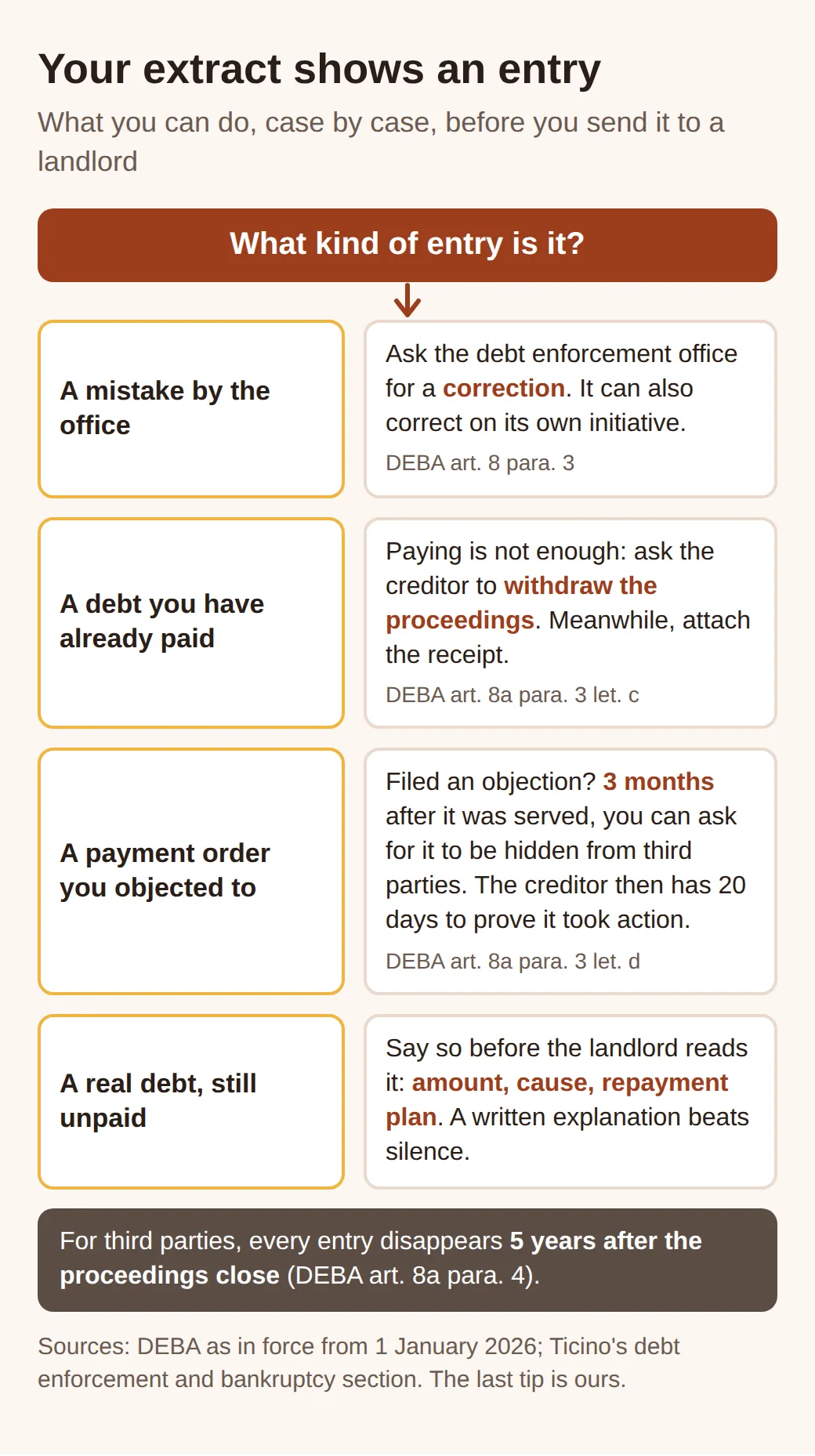
A mistake. If the entry is wrong, for instance because of someone with the same name, the office corrects it on its own initiative or at your request (Article 8 DEBA). All debt enforcement offices in Ticino can be reached on the same number, 091 816 63 00, Monday to Friday, as the page of the debt enforcement offices (in Italian) shows.
A debt you've already paid. Here comes a surprise: paying doesn't erase the proceedings. The debt enforcement office's FAQ (in Italian) puts it plainly: a paid debt stays on the register because it "può essere cancellato solo dal creditore o dal giudice", meaning only the creditor or a court can remove it. Ask the creditor to withdraw the proceedings and to inform the office: withdrawn proceedings are no longer shown to third parties. In the meantime, attach the payment receipt to your extract.
A payment order you objected to. If you filed an objection, within ten days of the payment order being served as Article 74 DEBA requires, and the creditor didn't take things further, you can ask the office not to disclose the proceedings to third parties. You can make the request once three months have passed since the payment order was served. The office then gives the creditor 20 days to prove they've started proceedings to have your objection set aside; if they don't, the entry no longer appears on your extract. Since 1 January 2026 the rule is more favourable: according to the Federal Office of Justice press release (in Italian), you can make the request at any time during the five years in which third parties can see the register, no longer only within one year. And if the creditor did start proceedings but lost them for good, proving that is enough to have the entry hidden again.
A real debt, still unpaid. There's no form to fill in here. Our advice: tell the landlord before they read it on your extract: a short letter with the amount, the cause and the repayment plan you've agreed, if there is one. A landlord who finds the entry on their own tends to assume the worst; one who gets the explanation together with the extract has something to weigh up. If your income is solid, a guarantor who signs the lease with you can make the difference.
Income and permit: the proof comes last
Proof of income is the last step, not the first. On the form, your annual income band is enough; you hand over your salary certificate or payslips only once the landlord has chosen you and the lease is about to be signed. If an agency asks every visitor for three payslips, it's asking for more than the factsheet considers proportionate.
The same goes for your permit. On the form, the landlord may ask for its type and expiry date; a copy of the document is only needed from the chosen applicant, to check what they wrote. To order the extract, though, you need a copy of both sides of your permit straight away, because it's the attachment the cantonal form asks for.
The factsheet itself allows one exception: subsidised or moderate-rent housing, where access depends on income or household size. There the landlord may ask for more, because they have to check that you qualify. In Lugano, for example, the questionnaire for moderate-rent apartments has to come with your latest tax assessment notice and the current year's salary certificates for everyone in the household, because income may not exceed four times the annual rent.
Before you send your application
The right moment to order the extract is when you really start going to viewings: if it shows an entry, you have time to act before a landlord reads it. Put a copy of your permit, if you have one, in the same folder and decide which band to give for your annual income. Payslips and a copy of your ID card can wait until the day a landlord chooses you.
When the lease arrives, the next step is the rental deposit: the rules and costs are in our article on the rental deposit in Ticino. Listings across the canton are on the page of apartments for rent in Ticino.
Common questions
I just moved to Switzerland: which debt enforcement extract can I give a landlord?
You can still order one from the debt enforcement office of your district, attaching a copy of your permit. It only covers the time since you've lived here, so it will be short but clean. Add a couple of lines explaining this, together with your employment contract.
Can a landlord in Switzerland ask for a criminal record extract?
The FDPIC factsheet does not list it among the information a landlord may ask for. The Data Protection Act treats data on criminal prosecutions and sanctions as sensitive personal data, and processing it on the basis of consent requires explicit consent. If a form asks for it, you can ask in writing what it is for before you hand it over.
How do I find out what data an agency kept after turning down my application?
Ask in writing: the Data Protection Act gives you a free right of access, and the answer is normally due within 30 days. If the agency has no reason left to keep your data, such as a waiting list you agreed to, you can ask for it to be destroyed.
Is a debt collection extract from Swiss Post as good as one from the debt enforcement office?
Swiss Post passes your order on to the competent office and, if you order online, emails you an electronically signed PDF. It costs 26.90 francs online and 35 francs at a branch, though, compared with 18 francs when you order directly from the canton.
Can a landlord ask for details about my guarantor?
Yes, to the same extent as about you: identity, contact details, income in bands and any debt enforcement proceedings or certificates of loss from the last five years. Here too, proof such as payslips may only be requested once the lease is about to be signed.
More from the blog
All posts
Ancillary costs in Ticino rentals: what you really pay
Ancillary costs on a Ticino rental: which items you pay, advance payments or flat rate, what the yearly statement must show and how to dispute a high bill.

Where is rent cheapest in Ticino? The five regions compared
Where rent is cheapest in Ticino: prices in the five regions from cantonal data, with train times and travelcard costs to Lugano.

Ending your lease in Ticino: notice period and forms 2026
How to end a rental lease in Ticino: three months' notice, a signed letter, the landlord's official form, 30 days to contest and a replacement tenant.